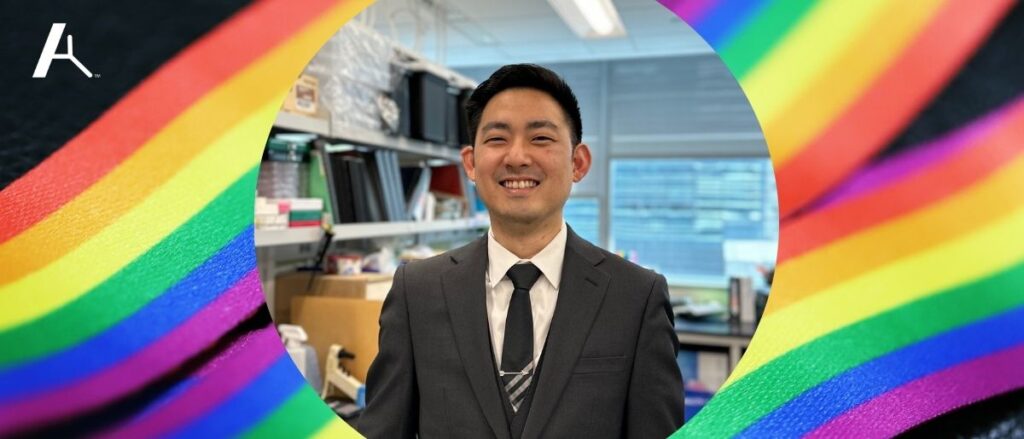
For Pride Month, we spoke with Stephen Yeung, PhD, an Assistant Professor of Immunology at Weill Cornell Medicine, about being an LGBTQIA+ scientist. Dr. Yeung is an AAI member and an Immunology Explained Ambassador.
As an undergrad, Dr. Yeung started off as a biomedical engineering major, but switched to public health policy and began conducting research in a neurobiology lab. He did his doctoral work in the lab of Kamal M. Khanna, PhD, first at the University of Connecticut and then at New York University when Dr. Khanna moved his lab. He started at Weill Cornell Medicine in 2020 as a Senior Research Scientist, and in 2024 became an Assistant Professor of Immunology there.
AAI: What inspired you to explore this field?
It was very serendipitous. One of my personal philosophies is that we are a cumulation of every person, thing, experience, etc. that we go through.
Going off to grad school, I reached out to Dr. Khanna about joining his lab for a rotation. I remember walking into his lab and seeing two people—the lab manager Leigh Maher and a PhD student Oriana Perez—and how excited both of them were about the experiments they were working on. Dr. Khanna showed me the amazing science he was doing in the lab on splenic tissue resident macrophages and L.monocytogenes infection, and I was blown away and wanted to understand it more.
AAI: Tell us about the science you are exploring.
My research program focuses around understanding how immune and non-immune cells and infections impact tissue homeostasis, how cellular galectins impact infections and inflammation, and how the peripheral immune system, galectins, and peripheral infections impact neurogenesis and neurodegeneration.
AAI: What is the philosophy on which you are running your lab?
My situation is a bit unique. Although I am a tenure track Assistant Professor, I was not given a start-up and I am still under another lab, so it is a bit of a lab within a lab situation.
I always remember my father saying, “Treat the people that work for you well, so if that means buying them lunch on random days or getting your hands dirty to help when they are overwhelmed or overworked or being a support during difficult times, just be there for them.” That is always ingrained in my mind and guides how I treat the people that work for me. If I can make their day-to-day life easier to come work in my lab, I will do it. Need food or snacks? Let me know what you need and I will stock my office with it. Need anything else? I got you. Need help with classes and understanding course material? Let’s block out time to go over it.
My lab currently consists of 5 amazing and dedicated undergraduate students from Hunter College (Matthew Pinos, Rafi Uddin, Farwa Tashin, Nina Yan, and Sarah Anees), and they are all either interested in pursuing a MD and/or PhD. They tell me their struggles with academic planning so I reach out to other Universities for resources and to provide additional pre-health advising. The pre-med students are planning on MCATs so we collectively blocked a Saturday this month to do a full mock exam where I’ll provide breakfast, lunch, and snacks so they just need to focus on the mock exam.
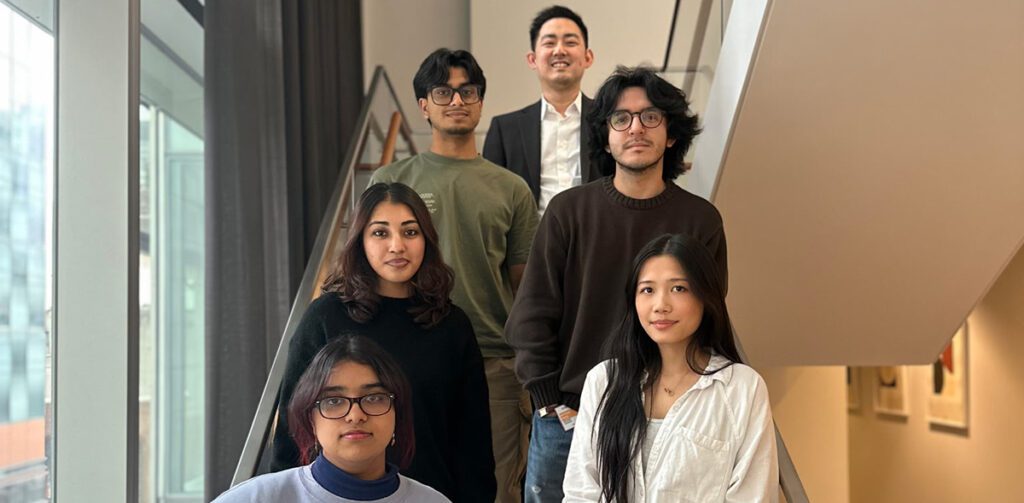
In my mind, aside from a mentor and supervisor, I am a resource for them and I will take the time to get them what they need to succeed.
AAI: Who are some of your professional mentors? How have they impacted your career?
People are usually shocked by this but I started my career, so to speak, for the City of Baldwin Park, California, in non-profit and policy work prior to going to college. During that time, I had mentors who guided me through the inner workings of public policy and public service.
My undergraduate and pre-PhD research mentors including Drs. Frank M. LaFerla and Mathew Blurton-Jones and senior lab members taught me perseverance, resilience, to challenge central dogmas and take on challenges, and that it’s never too late to start over or to learn something new. My clinical mentors Dr. Jean-Louis Selam, Pia Gatcheco, and Irene Rhodeman all taught me compassion towards patients of diverse backgrounds and to be free of prejudice.
My PhD mentor Dr. Kamal M. Khanna and senior lab mentors also taught me perseverance, resilience, to challenge central dogmas, to continue learning (techniques, topics, skills, etc.), and to ask the difficult questions.
Finally, my post-graduate and faculty mentor Dr. Lishomwa Ndhvlou taught me to remember the clinical applications of my work and to use words carefully since wording can have negative impacts.
AAI: Will you tell us a little about your experience as an LGBTQIA+ scientist?
I do strongly believe that visibility and representation is important and even more so in STEM. I still remember growing up, being gay was taboo—especially being of Chinese heritage.
When I started conducting research and having an openly gay lab manager, I still felt I could not be visible since I didn’t know of any LGBTQIA+ scientists in faculty positions. I often felt that if I came out I would be questioned or not accepted as a professional. And I feared for my own safety. It wasn’t until graduating and meeting my first boyfriend that I felt okay and supported to come out, but it was only to a few. I was not 100% visible including in the workplace.
But I fully accepted and embraced my identify and was fully out to everyone by the time I started my PhD in 2015. A part of it was because I felt like I was starting anew, and my cohort was so diverse in all aspects of life. Being 100% open and visible was internally challenged in 2016 when it was clear my identify is being politicized and my safety was a threat. I didn’t go back in the closet per se, but I would try and act more masculine out in public and not do anything that would be suggestive of homosexuality around strangers.
When I first heard about 500 Queer Scientists while at NYU, I felt safe to be open and to be visible since if I did face any challenge in my career, I knew where I can go to seek advice and guidance. That organization also sparked my being Out at NYU Langone on their internal OUTlist.
Being active in non-STEM research, I remember reading a study showing LGBTQ professionals in STEM experience increase inequality including career limitations, harassment, and professional devaluation by their non-LGBTQ peers. A goal of mine is to help create and launch an OUTlist at Weill Cornell Medicine. The visibility that 500 Queer Scientists really allowed me to accept who I am and to want to be that safe space for others who don’t “see” themselves in academic STEM positions.
AAI: What does the immunology community need to do to attract more LGBTQIA+ scientists and other under-represented groups? What do we need to do to help them thrive?
The immunology community and AAI are doing amazing with supporting under-represented groups through the Committee on the Status of Women and the Maximizing Access Committee (formerly the Minority Affairs Committee).
We can make changes and promote further visibility and opportunities by offering networking events or social events at the Annual Meetings. This would allow LGBTQIA+ Immunologists to network and socialize with other LGBTQIA+ Immunologists and connect in a safe area.
Having sessions that highlight the amazing science being conducted by LGBTQIA+ Immunologists at a dedicated session would be advantageous such as STEM Village providing an online webinar platform for LGBTQIA+ in STEM to present their research globally. Having fellowships and grant opportunities for the advancement of LGBTQIA+ immunologists and scientists in general would allow our community to grow and thrive.
AAI: How are you celebrating Pride this month?
To celebrate Pride this month, my only plan is to attend the NYC Pride March. But we all really need to remember what this month really means. LGBTQIA+ Pride Month is to honor the 1969 Stonewall uprising and our transgender superheroes, Marsha P. Johnson and Sylvia Rivera.
It is more than just historical reflection. It’s about celebrating openly expressing our authentic identities. It’s about advocacy to raise awareness about the discrimination we still face and memorialize those lost to hate crimes. Especially in this current time, we need to support our brothers and sisters. As most celebrate the L and G, we need to stand hand in hand for BTQIA+. Policies negatively impacting the Transgender community include removal from the military, changes on federal documents, and policies impacting care. In 2026 more than 10 transgender individuals have been murdered or died from suicide in the US alone.
So, to celebrate Pride Month, not only am I going to the NYC Pride Parade, but I am also reflecting on the past and the work that still needs to be done to provide equality to our community.
Connect with Dr. Yeung on social media here.