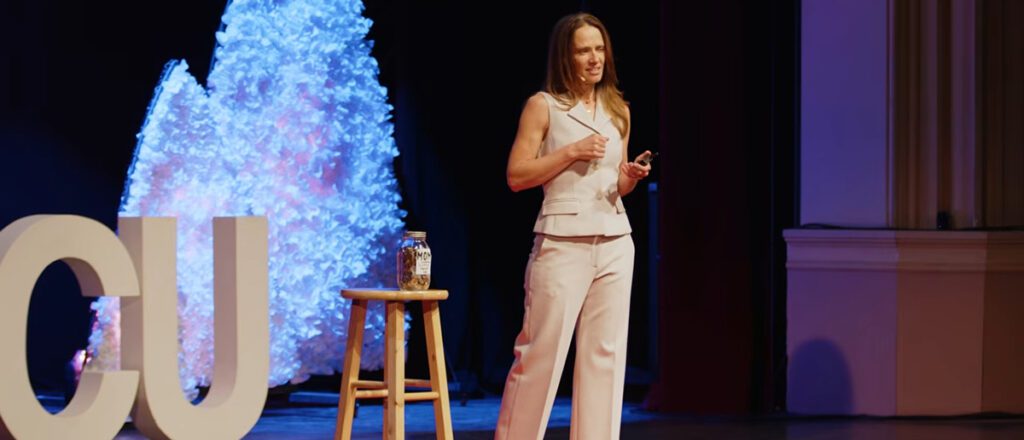
At home, Aimee Bernard, PhD, has a swear jar, but it’s not for swearing. Instead, she would put a quarter in it every time she talked about science when her daughter hadn’t asked. Dr. Bernard has always been passionate about science, and when her twins were growing up, she began thinking about ways to communicate her complex research in accessible, clear, and understandable language.
Now, Dr. Bernard is the new chair of the AAI Public Outreach Core Committee (POCC) and a tireless advocate for science communication. She is also associate professor in the Department of Immunology and Microbiology at the University of Colorado Anschutz School of Medicine, and assistant Director of the Humani Immunology & Immunotherapy Initiative. In a recent TEDxCU Talk, she described how important it is for scientists to be able to talk about research to a wide range of audiences, especially in a world full of misinformation about science.
Dr. Bernard leads an online workshop series hosted by the Colorado Clinical and Translational Sciences Institute on Communicating Your Science to the Public.
We spoke with Dr. Bernard about her efforts to get science communications methods into medical school curriculum, how scientists can find their voices, and how to come up with a good analogy.
AAI: What are the challenges scientists face when trying to communicate science to the public?
BERNARD: We need science communication training and skills. And that’s part of what I was trying to let people know with my TED Talk: if people think scientists are bad at communicating with the public, it’s because for our entire careers, all we’re rewarded for is using jargon, and we don’t get any training or encouragement to talk to people outside of our field of expertise.
AAI: Describe the science communications course you offer at CU Anschutz.
BERNARD: I’m trying to get science communication training integrated into medical and graduate education. I run a one credit course. It’s only mandatory for students in the master’s program in immunology and microbiology. But that was my way of kind of getting my foot in the door of required science communication training.
It’s only one credit, low stakes, so other master’s students can take it as an elective. It’s open to PhD candidates as well.
AAI: What kind of assignments did you give in your course?
BERNARD: We met for two hours at a time, and for the first hour it would be usually me introducing some topic in like an interactive way, but then the last half would be them working on, for example, their elevator pitch.
I guided them through what an elevator pitch is and how to write one, some example pitches. And then they would have time to work on it individually, before breaking them into groups to read them to each other and give feedback.
We also did storytelling—for example, the story of what inspired them to become a scientist. I also encouraged them to write about their research as a story. And we talked about the hero’s journey. The hero could be either you or your cell type, like the B cell. And then, what’s the tension or the problem that the hero needs to resolve. What’s their research question and what’s unique about it? How do they tackle it? How did the hero save the day? And what future directions might the hero take?
Their final project was an Instagram story or post. I gave them an example of Yasmin Mohseni, who’s on the POCC. She put up a really beautiful, very simple and clear, but easy to understand story. It was seven slides on Instagram when the Nobel Prize was announced. Her research is on T regulatory cells, so she described her research project through the context of the Nobel Prize. And then she went through her story and had some visuals and some pictures of her in lab and like presenting a poster.
I gave them her Instagram research story as an example of what I wanted them to make for their final project. Throughout the course, I gave them some time here and there to work on it and to get feedback from me as well.
AAI: How do you gauge your audience so that hitting the right level of detail and tone?
BERNARD: When I talk to my mentees and the students in this course, I tell them that there are five tiers. Your highest tier is how you explain something to a peer, a colleague. In my TED Talk, I gave you the Tier 5 explanation of how vaccines work, with all the jargon I would use if I was talking to a colleague.
Tier 4 is a scientist, but in a different field. I could probably use some jargon. I would have an assumed shared background of science, but they’re not going to know all the terms. Maybe this is an ecologist, someone who has their own lingo that I don’t understand, but they have the scientific background. So maybe I don’t have to explain what mRNA is, you know?
Tier 3 is what I would call the Scientific American group: people who are science curious. They would read the science section of the newspaper, or might have a subscription to Scientific American. They’re not scientists, but they’re interested in science enough that they seek it out.
Tier 2 is the non-scientist general public: your neighbor, or, probably a grandparent. Someone who might have questions like, “why should I get a vaccine?” You want to have your explanation ready to go for that person, assuming they don’t know any of the jargon. Maybe they’ve never thought about the answer or looked it up, but they’re asking you because they know you’re a scientist.
And then Tier 1 is kids. With them, we’re not lying at all, but we would maybe make it sound really exciting. Like, “oh, you wouldn’t believe what we just figured out in the lab!” Make it engaging, exciting, and have no jargon whatsoever. I you’re going to think about the word antibody, you would need to just unpack that completely and describe it in a different way. I might say, “these are like arrows that are released into your blood by the cell that’s like an archer, and those arrows are going into your blood trying to find the target, which is like a cold virus, the germ that causes the cold. So, simplifying to make it fun and engaging, and I think also inspiring.
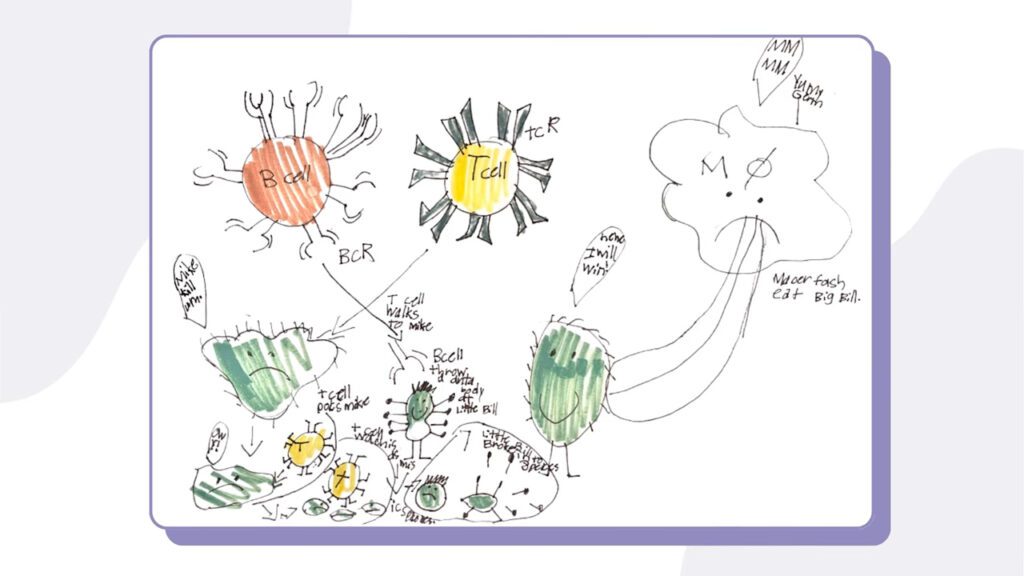
AAI: In your TED Talk, you use the analogy of a GPS updating its route to explain why science “changing its mind” isn’t a bad thing. How do analogies help communicate science?
BERNARD: When you give people analogies or metaphors, it lets them learn the information in a way that’s relatable. Another thing I used commonly during the pandemic was referring to COVID vaccines as seatbelts. They don’t necessarily prevent the crash, which in this case is the infection, but they do prevent serious harm, death, and hospitalization.
Everyone knows what a seatbelt is. You get in your car, you put your seatbelt on. You might still crash, but you’re going to have less harm than if you’re in the same crash without the seatbelt. So when I used that analogy to answer the question, “why can we still get sick?” I saw a lot of light bulbs turn on when I would use that analogy.
Analogies will often give visual cues. I think they can start to draw it out in their head or kind of map it, which I think for me is very powerful.
AAI: What should scientists avoid when talking about their science?
BERNARD: I hate when people say “dumb it down.” That’s condescending, and I prefer when people say “simplify,” or “approachable language,” or “easy to understand language.” But when people say, “oh, I just need to dumb it down,” I actually cringe when I hear that.
You could be talking to a lawyer, or your mechanic. Mechanics know the inside and outside of cars and how everything works. I don’t know anything about that. Whoever you’re talking to has a specialty in something. You are translating science, not dumbing it down.
Dr. Bernard can be found on Instagram at @funsizeimmuninja and at Think Like a Scientist, a non-profit, after-school program run by a diverse team of volunteer scientists and students at CU Anschutz.