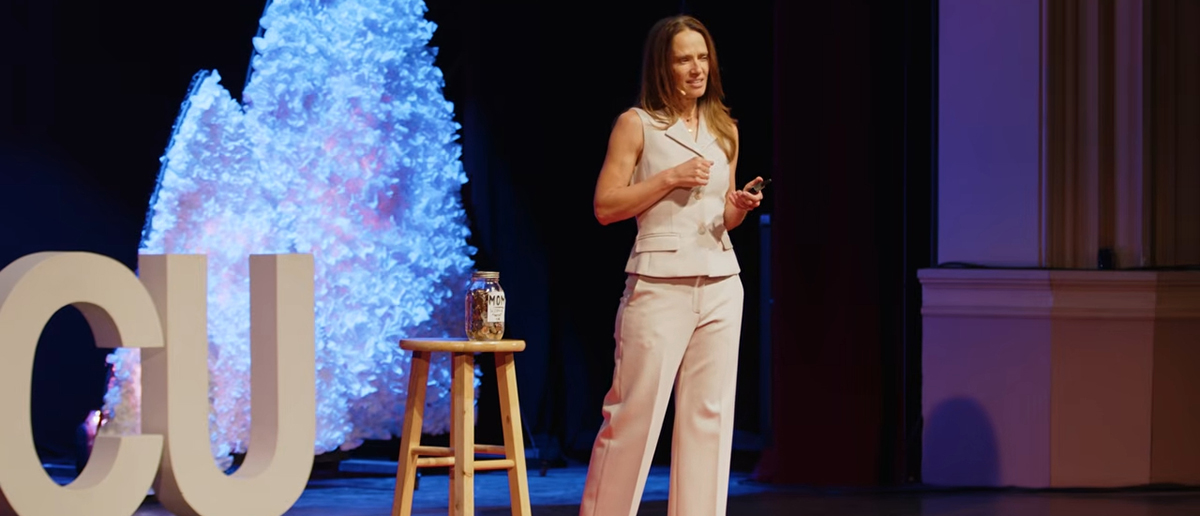
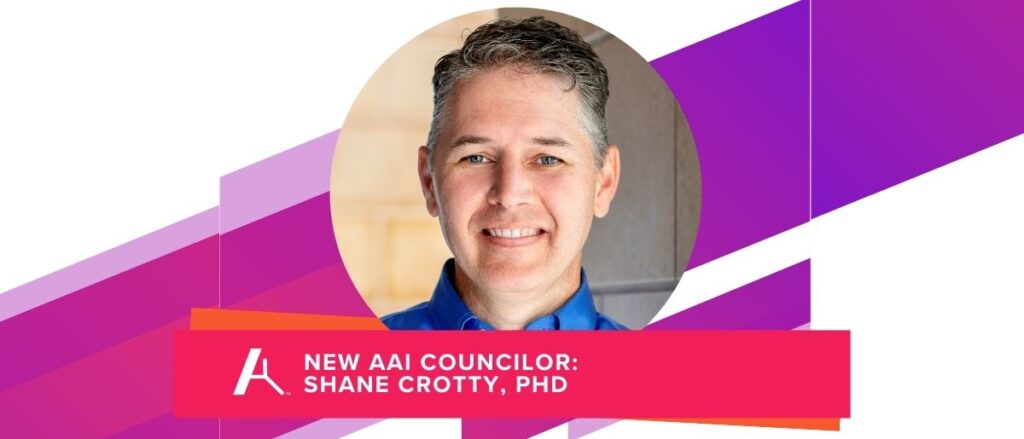
At IMMUNOLOGY2026™, Shane Crotty, PhD, got an early start to AAI leadership. He graciously stepped in at the last minute to give a well-received address in the first Distinguished Lecturer slot when the planned speaker was unable to attend due to illness. The next morning, the newly elected Councilor met with a lucky group of AAI members at the Deeper Dive session for a lively discussion.
Dr. Crotty officially joined the AAI Council on July 1, 2026, having been elected on the same ballot that brought about major revisions to the Association’s governance. “I think the restructure of AAI governance makes a lot of sense,” he told us. “I think fundamentally, It’s good to be doing elections with a shorter than seven-year future window, because as we see in the world nowadays, a lot of things change over seven years.”
Early Career
Dr. Crotty has dual undergraduate degrees from MIT in Biology and Writing and earned his PhD in Biochemistry and Molecular Biology at the University of California, San Francisco in 2001. That same year, he published a biography of Nobel laureate David Baltimore, PhD. This set a high bar for the intensity of his work, one which he has consistently matched.
He completed postdoctoral work with Rafi Ahmed, PhD, at the Emory University Vaccine Center before joining the faculty of the La Jolla Institute for Immunology in 2003. He is now a full professor and the Chief Scientific Officer at LJI, as well as co-director of the immunology track of the UCSD Biomedical Sciences Graduate Program.
Prioritizing National Science Policy
Dr Crotty cites the current “extraordinary federal government challenges” as the impetus that prompted him to run for Council. He sees AAI as having a key role to play in regaining and preserving public trust in science. “Virtually all the science that immunologists do has potential impacts on the public. Public trust in and support for what we do matters a lot. AAI, as the premier immunology organization in the US, has been cognizant of its importance in those areas and has been interested in improving its impact.”
National science policy has been a focus for Dr. Crotty for several years, at least since he challenged the 2017 NIH Grant Support Index that proposed capping the number of grants that a single lab could obtain. But his most prominent work in the policy realm was during the COVID-19 pandemic.
Science Communication During COVID
Early in the pandemic, Crotty and Alessandro Sette, DrBiolSci, also at LJI, published the first detailed analysis of the immune response to the SARS-COV-2 virus. Their research, which came out less than two months after the US instituted lockdowns and stay-at-home orders, showed that robust T cell response to the virus indicated promise for vaccine development. The attention gained from this work prompted Crotty to do more public science communication on Twitter (now called X).
“I really tried to do good science communication during the pandemic about what I thought was important and what I thought was safe,” Crotty said. “Probably the biggest one was when the Moderna and Pfizer vaccine trials came out a couple of weeks before Thanksgiving. These were extraordinary, massive clinical trials that were done in many, many people. In two independent clinical trials, they both had about 95% vaccine efficacy—and it was reproducible. And yet the news coverage was ‘these genetic vaccines work, but we don’t know enough about their safety yet.’ And I thought: that is not even close to the real message here.”
Thanksgiving was the first day Crotty had taken off since March, and although he was finally home with his family, he took some time to sit in a corner by himself and write out a Twitter thread asking and answering the question: “Are RNA vaccines safe?” And then immediately: “That’s a good question.”
Crotty felt it was crucial for the public to know that it was an important question to ask. The thread addressed how RNA vaccines work, how they are tested, and why there is pain associated with vaccine injections. His tweets took on a life of their own, and soon he appeared on MedCram, a popular YouTube program to explain RNA vaccines further. That interview has been viewed almost 3 million times, and many viewers have told Crotty that it empowered them to allay the concerns of relatives. As a bonus, he says, “it’s finally something I can tell my kids that they’d be impressed by.”
Apollo Moon Mission for HIV Vaccines
Dr. Crotty joined the AAI Council just as the culmination of 14 years of collaborative research toward a promising new HIV vaccine finally hit publication. He calls the enormous undertaking an “Apollo moon mission type project,” that seemed unreachable at its inception. “90% of people considered it impossible. And there were many reasons it was potentially impossible. So different fields, different technologies would have to be involved. We put together a real multidisciplinary team and tried to address those things one by one with the goal of developing an HIV vaccine.”
Like the Apollo project, the potential benefits of the vaccine endeavor go beyond the vaccine itself. “By starting fundamentally, we’re going to learn things along the way that are scientifically valuable for things that aren’t an HIV vaccine. We’re going to find things that are important for other vaccines, but also generally valuable for understanding the immune system. They might be relevant for cancer, for allergies, for understanding infectious diseases or autoimmune diseases in general.”
Scientist and Biographer
Most grad students are kept busy enough with their research, but Crotty found time to publish a biography along with his work in the lab. Ahead of the Curve: David Baltimore’s Life in Science covers the Nobel laureate’s life through personal interviews and archival oral histories.
“I definitely went to college intent on becoming a scientist and doing lab work. And then during that process, I also got very interested in writing about science for non-scientists,” Crotty said. “It really deepened my appreciation for the complexities of science and lives in science. I certainly learned about David Baltimore’s life, but also got to interview all kinds of other great scientists, you know, and talk about their most exciting findings or something interesting or complicated about their life.”
AAI Service and Awards
Prior to his election to Council, Crotty has served on the AAI Program Committee and Nominating Committee and has been an associate editor for The Journal of Immunology. He has also taught in the AAI Introductory Course for several years. Crotty is the recipient of the AAI-BioLegend Herzenberg Award, and the AAI-BD Biosciences Investigator Award.