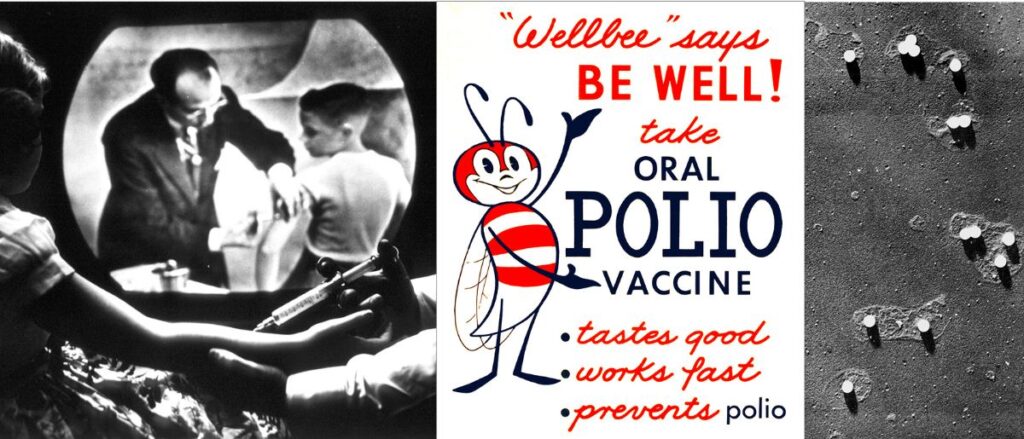
For the full history of how the polio vaccines were developed, read AAI’s three-part story: Part 1, Part 2, Part 3.
In the late 19th century, sporadic outbreaks of a perplexing and debilitating disease began to appear in both the United States and Europe. Most of those affected, primarily young children, would experience a fever and perhaps some pain or stiffness and then recover. But in a small percentage, the disease would progress to paralysis of legs or the diaphragm, sometimes leading to death.
Poliomyelitis, or simply polio, presented medical researchers and early immunologists with special problems that grew more urgent as outbreaks became epidemics and the effects of the disease more severe. From its inception, The Journal of Immunology published some of the most important research on the nature of polio, ultimately leading to the successful vaccines of the 1950s.
Several polio epidemics struck the United States in the first half of the 20th century, leaving many children and adults with lifelong disabilities, confined to an iron lung, or dead. During World War II, polio cases again began rising in the United States. In 1944 alone, there were 19,029 cases and 1,433 deaths.
Basic Research Breakthrough
Although polio was the second-most-researched disease after influenza, advances were limited by the inability to culture the virus. Three researchers at Harvard Medical School stepped in to eliminate this hurdle. John F. Enders (AAI 1936, president 1952–53) already had two major accomplishments under his belt that helped lead to the breakthrough. He had previously developed a vaccine for feline distemper, and, with his colleague Thomas Weller (AAI 1943), had been the first to successfully grow the mumps virus in vitro. Frederick C. Robbins (AAI 1952) soon joined as the third member of their team.
In 1948, Enders and Weller developed the first successful method for growing the mumps virus in vitro using a culture of mainly chicken-embryo fragments and ox blood. Weller then took that method and attempted to grow the chicken pox virus in vitro with embryonic human muscle and skin as the culture, with the addition of a combination of penicillin and streptomycin to eliminate bacterial contamination.
Crucially, Weller discovered that if the nutrient media was changed at regular intervals, the tissue would live longer, thus allowing more time for the virus to propagate. At Enders’s suggestion, Weller added Lansing Type II poliovirus to some leftover culture flasks from his chicken pox experiment. At the same time, Robbins was readying his mouse intestine cultures for experiments to identify viruses responsible for infant diarrhea and used the Lansing strain in a few of his flasks.
Poliovirus grew successfully in Weller’s cultures; it did not in Robbins’s. Weller’s successful experiment led the team to quickly refocus all their research on growing poliovirus in vitro.
A Key Discovery
Up to that point, polio was still considered primarily a disease of the nervous system. But the composition of Weller’s culture, combined with the abundance of recent research showing that poliovirus was found in the gastrointestinal tract of humans, inspired the three scientists to attempt to culture it in non-nerve human embryonic tissue, including intestine.
The team successfully cultured all three strains of poliovirus, opening up the possibility of in vitro studies of the virus and finally enabling rapid development of effective vaccines. For this discovery, Enders, Weller, and Robbins were awarded the 1954 Nobel Prize in Physiology or Medicine.
Polio Epidemics
The basic science breakthrough for replicating poliovirus occurred in 1949, a year also marked by a huge surge in polio cases. The increase reflected the beginning of the Baby Boom. Because polio was primarily a disease of the young, this increasing population of children in the United States provided the virus with more potential victims and carriers.
The need for a vaccine was as pressing as it had been during the 1916 outbreak, except this time there was a light at the end of the tunnel. Multiple researchers were actively developing new vaccines based on a clearer understanding of poliovirus.
Jonas Salk
Jonas Salk (AAI 1947) benefited greatly from the mentorship of Thomas Francis Jr. (AAI 1930, president 1949–50). In 1940, Francis isolated the influenza B virus while Salk was on the staff of Mount Sinai Hospital. As Salk later described it, he “saw the opportunity…to test the question as to whether we could destroy the virus infectivity and still immunize.”
In 1942, Salk followed Francis to the University of Michigan School of Public Health, where they created a killed-virus vaccine for influenza. Three years later, the United States Army—which had been the major funder of the research—administered the vaccine to eight million soldiers, reducing their rate of infection by 92 percent in that year’s epidemic. This success would be the model for Salk’s later work on polio.
The Salk Vaccine
In 1947, at the University of Pittsburgh School of Medicine, Salk built on the work of Enders, Weller, and Robbins, and applied the techniques he had refined with influenza to develop a killed-virus vaccine for polio. The driving principle behind using inactivated virus was to streamline the testing process to get a vaccine to the public as quickly as possible.
After growing large quantities of poliovirus in a culture of monkey kidney cells, Salk killed the virus with formaldehyde and injected this inactivated polio vaccine (IPV) into monkeys. When the tests showed that the vaccine produced immunity as evidenced by a specific antibody response, Salk moved on to humans. The clinical trials of the Salk vaccine began in 1952.
The first small trials were conducted at institutions near Pittsburgh and successfully demonstrated antibody production in humans after vaccination. The following year, a pilot study with 15,000 children (including Salk’s own sons) was undertaken to optimize the vaccine schedule.
Polio Pioneers
In 1954, the largest field trial of a vaccine in history began. Designed and led by Francis, now the director of the University of Michigan Poliomyelitis Vaccine Evaluation Center, the year-long nationwide clinical trial was conducted by over 100 researchers on nearly two million children who volunteered for the study—some receiving the vaccine, and others a placebo—at a cost of over $17 million (more than $211 million in 2026 dollars).
All the volunteers received a “Polio Pioneer” card certifying their participation. On April 12, 1955, the 10-year anniversary of President Franklin Roosevelt’s death, a national and international press contingent arrived at the overfilled Rackham Auditorium of the University of Michigan, where Francis declared on live television that the Salk vaccine was safe and effective. Later that day in an interview with Edward R. Murrow, Salk told the celebrated interviewer that “there is no patent. Could you patent the sun?”
Throughout the spring and summer of 1955, children around the country lined up to receive their newly-approved shot at local elementary schools, a logistical marvel that involved training 60,000 medical personnel, 64,000 teachers and principals, and 220,000 volunteers.
The Cutter Incident
Only two weeks into the initial vaccine rollout, reports of polio symptoms in a few vaccine recipients began to emerge. The surgeon general placed a pause on all vaccinations on May 8, 1955, while the cause was determined. Investigators discovered that Cutter Laboratories had released a batch of 120,000 doses of the IPV that contained live poliovirus.
The error’s cause was cell debris that prevented sufficient exposure of the virus to the inactivating agent. Additionally, poor oversight from the LBC allowed the active-virus doses to be distributed to and injected at vaccination sites. A third of these doses resulted in children contracting abortive poliomyelitis, a form which produces minor symptoms, because it does not involve the central nervous system, but which is still transmissible. Worse, 56 children developed the paralytic form of the disease, resulting in five deaths. Another five children died and 113 were paralyzed after contracting polio from one of the vaccine recipients.
The Cutter incident was one of the worst pharmaceutical disasters of all time, but the comprehensive investigative response and increased federal safety protocols it triggered ensured that the 400 million doses of the Salk vaccine produced from 1955 to 1962 were safe and effective. Several of the officials involved in the original licensing and safety decisions resigned, including Health, Education, and Welfare Secretary Oveta Culp Hobby and NIH Director William H. Sebrell Jr.
The children and families who benefitted from successful vaccination responded with a flood of letters expressing their appreciation and relief at being freed from the horrible dread of polio. Looking back on the tragedy, John Enders wrote that the lesson to be learned was that “we must never again allow decisions about essentially scientific matters to be made for us by people without training or insight.”
Albert Sabin
In 1936, working with Peter Olitsky (AAI 1917) at the Rockefeller Institute, Albert Sabin (AAI 1946) had been successful in cultivating poliovirus in vitro in human embryonic nervous tissue, but that experiment had used a strain that had undergone 20 years of brain-to-brain passage in experimental monkeys. Thus, when the same virus failed to grow in non-nervous tissue, it appeared to confirm the common finding that polio was only a disease of the nervous system.
Five years later, Sabin confirmed that the gastrointestinal tract was the “primary localization or portal of entry” for the poliovirus. Instead of relying on samples sent to his laboratory, Sabin and his assistants personally travelled to morgues in Ohio, Indiana, and West Virginia during an epidemic in 1940 to perform autopsies on every polio fatality they could. Their extreme precautions regarding sterile instruments allowed them to confirm that the poliovirus entered the body via the gastrointestinal tract rather than the nasal route.
Sabin’s work on polio was interrupted by the Second World War, but when Enders, Weller, and Robbins developed the technique to culture the poliovirus, he began work on a live-virus vaccine, attenuated by being passed though monkey tissue repeatedly. This oral polio vaccine (OPV) produced immunity faster than the IPV, provided both humoral and cell-mediated immunity, and entered the body by the digestive system just like the actual virus.
OPV Trials Abroad
In 1958, Sabin convinced the Soviet Union to allow a field trial of his live-virus vaccine using five times the number of children involved in the Salk trial: 10 million participants, all of whom received the vaccine, with no control group. The USSR had experienced its first widespread epidemics of polio only after the Second World War, but since then had suffered major outbreaks in all of its republics. The OPV, given in a sugar cube, was easier to administer than an injection, and compared to the Koprowski vaccine, had the benefit that recipients would shed weakened vaccine—rather than potent virus—in their stool.
Legacy of Polio Vaccines
In 1961, the Sabin OPV was approved in the United States. It overtook the Salk IPV due to its ease to administer and the more robust and longer lasting immunity it provided. These advantages were especially pronounced in countries where polio was endemic: the need for sterile syringes made thIPV unsuitable for mass vaccinations, and the OPV provided immunity in the intestinal tract, which aided in preventing infection by the wild-type strain of the poliovirus.
In 1994, polio was declared eradicated from the Americas thanks to the two vaccines. With the threat of polio almost non-existent, the U.S. government recommended a return to IPV in 1999 to avoid any chance of a recipient contracting polio from the attenuated virus in the Sabin vaccine. Since then, the Salk vaccine has remained the standard in the United States. Today, the World Health Organization recommends a combination of the OPV and IPV in areas where polio is endemic or new outbreaks occur.