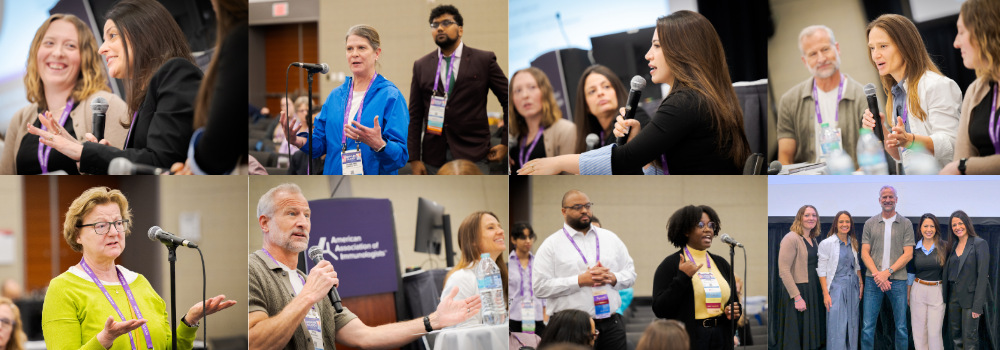
In an era where misinformation spreads quickly, and public trust in science is increasingly strained, scientists have a unique opportunity—and responsibility—to help close the gap. At IMMUNOLOGY2026™, the AAI Public Communications Committee (PCC) convened a dynamic panel including Dr. Jess Steier, The Evidence Collective and Unbiased Science, Dr. Liz Marnik, The Evidence Collective and Those Nerdy Girls, and Dr. Yasmin Mohseni, A2 Biotherapeutics and Member of AAI’s PCC, for a candid conversation about how scientists can communicate more effectively, empathetically, and with greater impact.
The panelists answered questions for over an hour, providing practical tips for scientists looking to increase their communication skills. Five key takeaways from their session are below.
Lead with Humanity to Build Trust
Panelists emphasized building trust requires a human connection, not just credentials or facts. When scientists lead with titles, degrees, or institutional authority, audiences may feel talked down to or excluded. Instead, communicators who introduce themselves first as parents, neighbors, or community members are more likely to be heard.
Dr. Marnik shared this is why she often talks about being a mom, a runner, and a hiker, in her content. Dr. Mohseni added, “My science account was originally my personal account, so people saw this 29-year-old grad student fumbling around in the lab, around London, trying to figure out life. Then, when I started to talk about science and COVID-19, I was already more trustworthy because people saw I was a normal person in addition to my credentials.”
Sharing glimpses of the person behind the account, helps dismantle perceptions of elitism and allows scientific expertise to be seen as coming from a relatable, trustworthy source.
Lean into Uncertainty
A challenge in science communication is that immunology is incredibly technical and requires nuance. The panel shared how this goes against what makes content popular on social media. Misinformation thrives because it offers confident, absolute claims that feel actionable and emotionally reassuring. As Marnik said, “false information gives people a false sense of empowerment, but understanding the science is also empowerment.”
The panelists emphasized that respecting audiences means being honest about uncertainty and saying, “we don’t know yet” or “this may change as evidence evolves,” all while clearly explaining how scientific processes work. Rather than avoiding complexity, the panelists stressed that people respond positively when nuance is framed as transparency rather than indecision.
Science Communication is More than Social Media
While social media featured heavily in the discussion, panelists were clear that effective science communication extends far beyond online platforms. Community events and everyday conversations are also powerful ways to communicate with the public.
Not everyone who mistrusts science is active online, and some of the most meaningful influence happens indirectly—through coworkers, family members, or trusted local figures. “All of us are trusted messengers to somebody in our life. So, even if you don’t have social media accounts, you can talk about your science and to reach the people in your community,” said Marnik.
How to Engage with Those Who Don’t Agree with You
Many attendees asked questions on how to interact with people who believe conspiracy theories or extreme misinformation. Overall, the panel admitted that no one will be able to change everyone’s mind or way of thinking. “Conspiracy theories are the most challenging to dismantle. I accept that there are some people I can’t reach. I do still try to talk to those people, and I don’t lead with science but instead try to say, ‘Okay I see why you might believe this because it’s all over the internet, but here’s something you might not have considered.’ This allows me to add science into the conversation if they are open to it,” shared Dr. Steier.
The panelists all noted that success should not be measured solely by changing minds immediately, but by planting seeds, reaching undecided audiences, or simply making credible information visible. “It should be counted as a success that someone who disagrees with you saw your video, because it got on their algorithm. By them engaging with your content, maybe the algorithm will feed them more. That in and of itself is a success,” said Steier.
Boundaries are Important
The panelists also addressed the emotional toll of public-facing science communication, particularly online. They underscored that it is neither realistic nor healthy to engage with every critic or negative comment. Setting boundaries, such as limiting who can comment, filtering direct messages, or choosing not to respond, is necessary for long term success. Marnik put it into perspective saying, “You should not feel like it is your job to reach everyone. If you reach just one person you are doing a good job.” Protecting mental health, they argued has been essential to their longevity in science communication.
To learn more about AAI’s role in science communications, visit ImmunologyExplained.org.
Photos by Abby Greenawalt