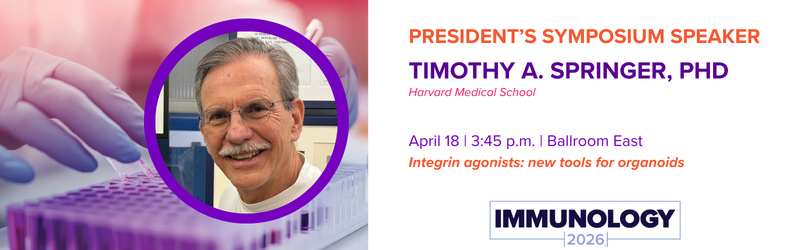
As part of the President’s Symposium on Saturday, April 18, at IMMUNOLOGY2026™, Timothy A. Springer, PhD, will speak on “Integrin agonists: new tools for organoids.” Dr. Springer is Latham Family Professor of Biological Chemistry and Molecular Pharmacology at Harvard Medical School.
Using monoclonal antibodies, Dr. Springer discovered, cloned, and functionally and structurally characterized many of the adhesion receptors in the immune system. He was the first to demonstrate that lymphocytes and leukocytes had adhesion molecules. His work on these receptors has advanced to characterizing their interactions and allosteric transitions by x-ray crystallography, electron microscopy, and laser tweezers force spectroscopy.
We spoke with Dr. Springer about his upcoming President’s Symposium lecture as part of a series of interviews with IMMUNOLOGY2026™ speakers.
How would you describe your lecture to a nonspecialist in 30 seconds?
Adhesion molecules and chemoattractants determine where cells go in the body. I will describe a new approach using synthetic hydrogels to zonulate tissues that could be applied to lymphocyte and leukocyte trafficking to create specialized niches where immune responses occur.
Why should immunologists know more about the adhesion cascade?
It instructs cells where to go in the body. The same principles that govern where in the bloodstream cells
emigrate into the tissues also organize the niches that leukocytes occupy in lymphatic tissues and tumors and are critically important in governing immune responses.
What was the path that led you to the research you are discussing in your talk?
Early on, my lab and others discovered antibodies that stabilize integrins in high or low affinity conformations. Activating antibodies enhance growth of organoids from stem cells. This led me to discover the principles that activate the integrin signaling required for stem cells to develop into epithelial organoids. My lab is harnessing knowledge about integrins as well as growth factors to create new synthetic materials for organoids and for zonulating tissues.
What are you looking forward to at IMMUNOLOGY2026™?
Learning about novel approaches for preventing autoimmune disease. I continue to be amazed by new
discoveries about T cell subsets, including those that secrete granzyme K to activate complement, and those that express particular T cell receptor beta chain subfamilies associated with autoimmune disease. Plus, perhaps I will meet a grad student who wants to be a postdoc fellow in my lab.