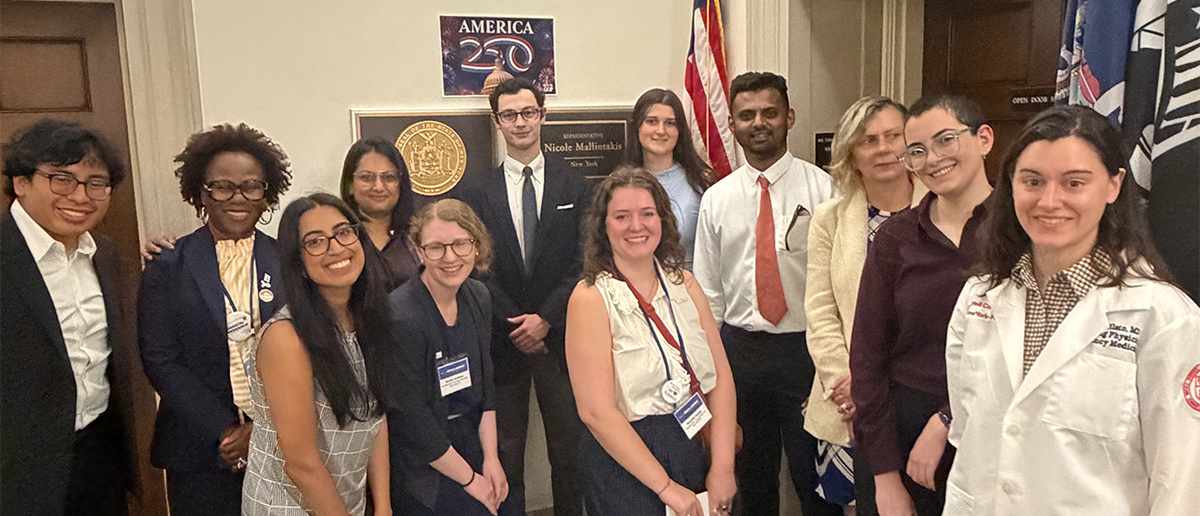
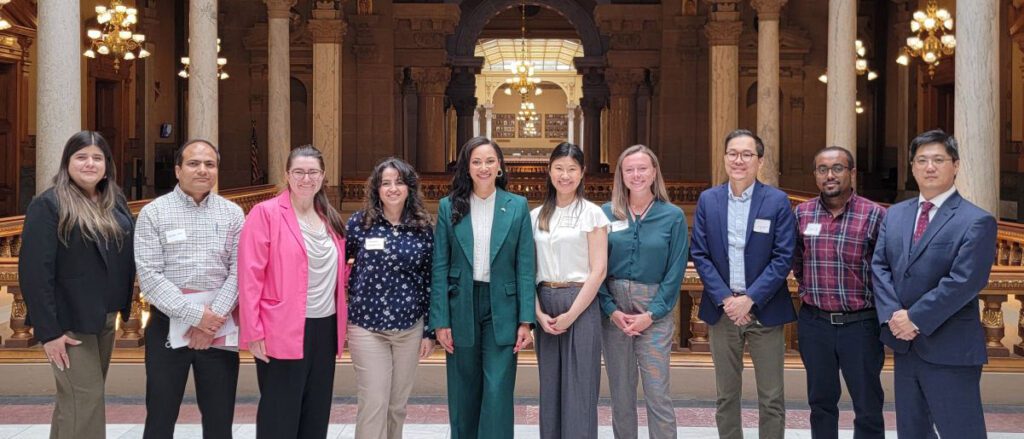
Last month, Cherry Cheung, PhD, a member of the 2025–26 cohort of the AAI Public Policy Fellows Program (PPFP), organized a visit to the Indiana Statehouse for a group of scientists to speak with lawmakers and learn about how they can be involved in the policymaking process. Engineers & Scientists Acting Locally (ESAL) served as the fiscal sponsor for the event and helped manage the grant funding from Research!America and the Union of Concerned Scientists.
Dr. Cheung has volunteered with ESAL on their communications team for a few years. There, she has “seen how ESAL supports civic engagement activities and helps scientists connect with their communities.” We spoke with her about the event and how her PPFP experience helped prepare her for advocacy.
AAI: What did you do to help the group of scientists prepare for the event?
Cheung: For this initiative, we worked together to build a three-part process. The first step was a Civic Engagement 101 workshop for STEM trainees in Indiana. The second step was a preparation workshop for the selected cohort, where we helped participants get ready for the Statehouse visit by developing their one-pagers, thinking through how to introduce themselves, and preparing for what it would be like to meet with legislative offices and policymakers. The final step was the in-person Statehouse engagement day itself.
My role was to help design and organize that experience from start to finish and make sure participants felt prepared and supported
AAI: Were there particular issues or active legislation you wanted to advocate for or learn about during your visit?
Cheung: This was a nonpartisan educational activity, so we were not there to advocate for any particular bill or issue.
What was especially valuable, though, was learning more about how scientists can engage during the legislative session. One of the most useful things I learned is that scientists can actually sign up to give testimony as subject-matter experts when bills related to their expertise are being heard. That was really meaningful to me, because as scientists we often think about how to contribute beyond sending emails to legislators.
Learning that there are more direct ways to participate in the process was one of the biggest takeaways from the visit.
AAI: What initially attracted you to the Public Policy Fellows Program?
Cheung: What first attracted me to the Public Policy Fellows Program was my experience participating in AAI Capitol Hill Day in Washington, DC. That experience really changed how I thought about advocacy and public engagement.
Before that, I think I had assumed that talking to legislators would feel intimidating or difficult. But after going, I realized how approachable those conversations can be, how much legislative offices genuinely want to hear from scientists, and how important it is for scientists, especially immunologists, to speak up for science.
That experience was what really motivated me to apply for the program. I was also very fortunate to have support from my PI at the time, Mark Kaplan, and I’m also grateful to Randy Brutkiewicz for his support and nomination.
AAI: How did the PPFP prepare you for this sort of advocacy work?
Cheung: The Public Policy Fellows Program helped me see that this kind of engagement is not as intimidating as many scientists imagine. It gave me the confidence to bring a similar idea back to Indiana so that other scientists could have a chance to experience something similar to what I experienced in Washington, DC, even if on a smaller scale.
It helped me understand how to prepare for meetings with policymakers, how to develop materials like a one-pager, and how to think about building long-term relationships with legislative offices. More importantly, it reinforced that scientists do not need to be policy experts before they show up. Their expertise is science, and that is exactly what policymakers want to hear from them.
AAI: Is there anything else you would like to add?
Cheung: I would really encourage scientists to take part in opportunities like Capitol Hill Day or similar public engagement programs if they can. You do not need to assume that you have to know everything before you go. Your expertise is your science, and that is valuable.
I also think it’s important to remember that these conversations are two-way. You are there to share your knowledge, but legislators and their staff are also there to ask questions, learn from you, and help you better understand their work and their communities. That two-way exchange is what makes these experiences so meaningful.