
Cerebral malaria (CM) is the deadliest complication of Plasmodium infection, disproportionately affecting children under five. As drug-resistant parasites become more common, treatment for CM becomes more difficult. Given increasing evidence that CD8 T cells are key drivers of CM, Sara E. Hamilton, PhD, Associate Professor of Laboratory Medicine and Pathology at the University of Minnesota, along with Geoffrey Hart, PhD, Assistant Professor, Division of Infectious Diseases and International Medicine at the University of Minnesota, have been researching interventions that can restrict CD8 T cell pathology.
Could IL-15C Treat Cerebral Malaria?
Dr. Hamilton and Dr. Hart previously observed that treatment with IL-15 complex (IL-15C) protected mice from experimental cerebral malaria (ECM), and that NK cell production of IL-10 was necessary for this protection. Following this thread, their latest research, published in The Journal of Immunology, further investigates how IL-10 affects immune responses in ECM following IL-15C treatment.
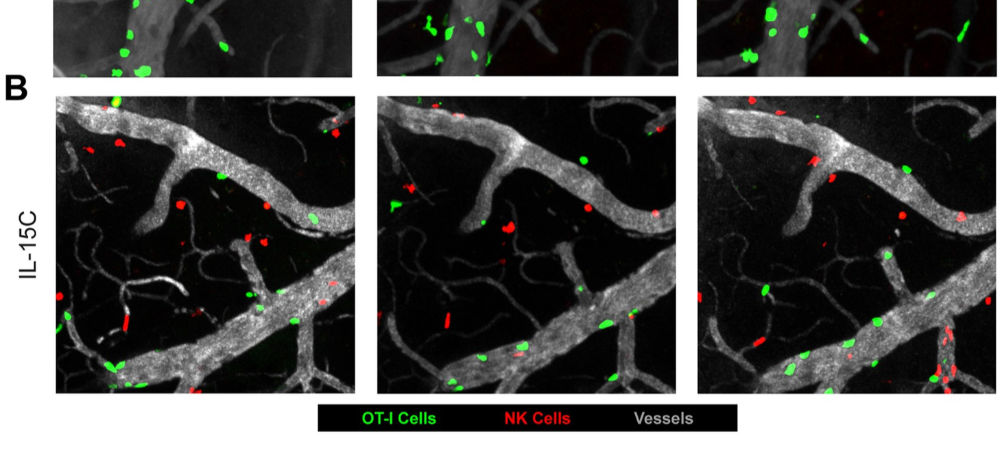
In a mouse model of ECM, CD8 T cells attack the brain endothelium. Disease occurs as endothelial cells upregulate adhesion molecules and cross-present malaria antigen to arrest T cells, damaging the blood-brain barrier. In mice treated with IL-15C, both T cells and NK cells are less prone to arrest, preventing damage and therefore protecting against ECM.
What is the role of IL-10?
When focusing on the role of NK cell–secreted IL-10 in this protection, the researchers wanted to know which cells were affected by treatment. Surprisingly, they found that all IL-15C–treated mice were protected from ECM, even mice whose CD8 T cells could not sense IL-10. This led the researchers to consider whether NK cell–secreted IL-10 was acting directly on endothelial cells.
To answer this, the researchers compared mice whose endothelial cells could sense IL-10 to those who could not. IL-15C treatment remained protective in the mice who could sense IL-10, but protection was significantly reduced in mice that could not. The researchers concluded that rather than IL-10 acting directly on CD8 T cells during ECM, it predominantly acts on the brain endothelial cells. Further investigation revealed this was due to IL-10 reducing MHC class I and expression of integrin ligands on endothelial cells.
“I hope that the field will consider the understudied and beneficial immunoregulatory capabilities of NK cells, which through production of IL-10 can limit inflammation, and in this case blood-brain barrier damage,” shared Dr. Hamilton, senior author of the study.
“This research should encourage cytokine therapies and NK cells to be further investigated for their potential to mitigate diseases and redirect immune responses to one day benefit patients with CM,” added Dr. Hart.
Dr. Hart and Dr. Hamilton plan to expand their studies on T cell and NK cell interactions with endothelial cells in different tissues and disease settings as they want to understand how different types of immune cells interact with the endothelium.