Poultry and pork farming are growing, multi-billion-dollar industries that require healthy stocks of animals. But diseases such as Highly Pathogenic Avian Influenza (HPAI) and Porcine Reproductive and Respiratory Syndrome (PRRS) threaten their economic viability and sustainability. As demand for high-quality protein rises, disease resistance becomes more important. Genome editing is a powerful approach that can accelerate improvement of traits within a few generations of reproduction.
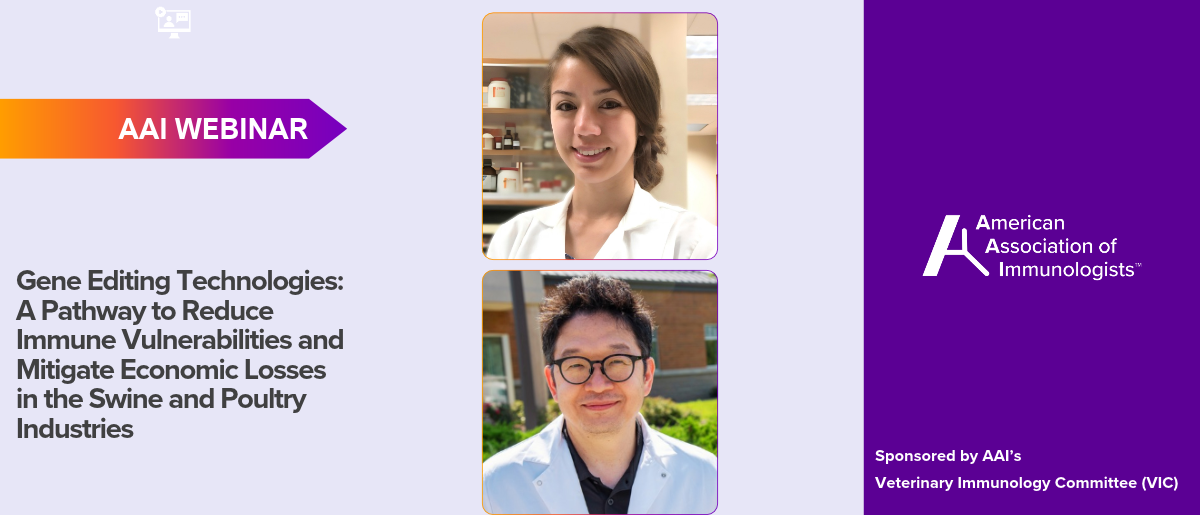
AAI recently held a webinar, sponsored by the Veterinary Immunology Committee, to explore the approaches that immunologists are using to produce animals with greater resistance and resilience to pathogens. “Gene editing technologies: A pathway to reduce immune vulnerabilities and mitigate economic losses in the swine and poultry industries” is now available for on-demand viewing.
Webinar speakers
The webinar featured two distinguished genetic engineers from the University of Missouri, Columbia: Paula Chen, PhD, a Research Molecular Biologist at USDA-ARS; and Kiho Lee, PhD, the Director of the National Swine Resource and Research Center (NSRRC), and Professor in the Division of Animal Sciences. The moderators were Jeffrey A. Yoder, PhD, Executive Director of the Genetics and Genomics Academy, and Professor in the Department of Biological Sciences at North Carolina State University; and former VIC Chair Maisie Dawes, DVM, PhD, Food Animal Internist and Immunologist at Western University of Health Sciences, College of Veterinary Medicine.
A vulnerable poultry industry
Dr. Chen’s talk, “Preventing Diseases in Poultry Through Genome Editing” focused on the potentials of using genome editing technologies to create birds that are resistant to many different pathogens and also possess improved production traits.
Avian influenza is the biggest viral treat to the poultry industries. Since the beginning of the outbreak of highly pathogenic avian influenza in 2022, over 200 million birds have been affected in the United States alone. The USDA currently has a stamp-out policy: if one case is confirmed on a facility, then all of the birds must be culled.
Producing better birds
Dr. Chen described how genome editing can be used to produce birds that are resistant or resilient to infection. The gold standard would be resistance, but targeting multiple points can create an animal that is highly resilient, with greatly reduced symptoms and risk of transmission.
Genome editing using chicken eggs and CRISPR-Cas9 can take two years to get a generation for functional studies. Using primordial germ cells, the cells that are essentially precursors to sperm or oocytes, a researcher can obtain useful tissue in just a few days.
Dr. Chen described the process her lab and colleagues use to identify genes that show promise, and the challenges of finding genes that can be knocked out without preventing embryonic viability. Her goal is to refine a library based on the hits from this survival screen, rescreen cells, and eventually validate a few targets with multiple strains of avian influenza viruses.
Going the whole hog
Dr. Piho’s talk, “Enhancing the Genetic Value of Pigs Using Gene Editing Technologies,” dealt with animals that are a source of not only billions of pounds of food, but potential transplant organs. Pigs are also excellent models for human disease research.
As with poultry, the barrier to swift research has been the low efficiency of genetic modification. Even with CRISPR-Cas9 technology, it still takes over a year to get progeny from a founder. But this process can be made much faster through cloning technology to generate gene-edited pigs from cultured cells.
Transplantation success
Dr. Piho related the story of a clinician calling to ask whether a transplanted heart valve would grow with the infant patient. He obtained some pigs that Dr. Piho’s lab had modified to express a jellyfish protein that fluoresces under UV light. With those green-glowing pigs, he made several transplantations and found that the valves did indeed grow with the recipient.
The next step was the first human partial heart transplant on Baby Owen, performed by Joseph Turek, MD, PhD. Dr. Piho is proud that these pigs led to the new standard of care for infant congenital heart defects, preventing multiple surgeries as they grow up.
Developing a resistant pig
The pork industry produces over 100 million pigs a year, but loses up to 10 million to disease, especially the Porcine Reproductive and Respiratory Syndrome (PERS) virus. The economic impact of these losses is enormous. Dr. Piho’s lab set out to develop a PERS-resistant pig.
The lab’s method was to deliver CRISPER-Cas9 reagents using a very thin needle after in vitro fertilization. From those founder animals, they bred CD163-knockout pigs that, when challenged with PERS virus, showed not just resilience but clear resistance to the disease, with no antibody reaction. With FDA approval, these pigs are now set to enter the market.
Catch up with the webinar
Watch the full webinar now to see the data on these and other studies that are advancing the field of gene editing in agricultural animals.