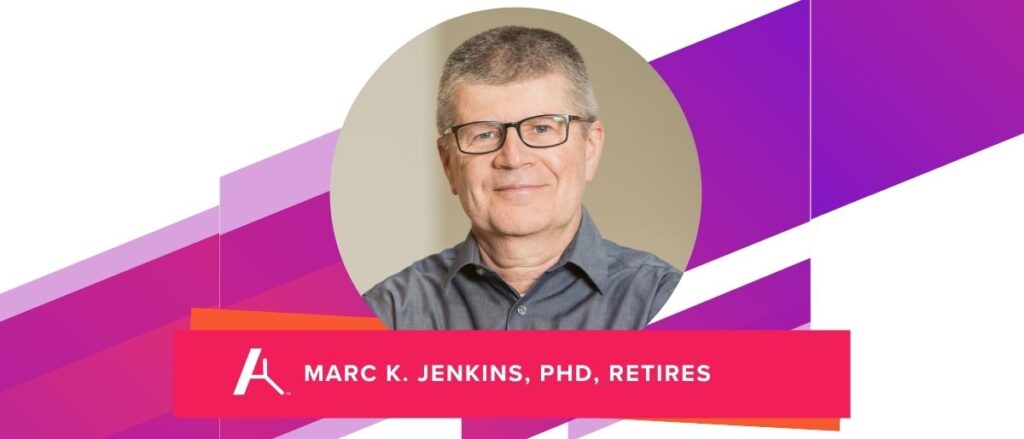
On September 14, colleagues and lab alumni will gather at the University of Minnesota to honor Marc K. Jenkins, PhD, as he retires from a long career of research, teaching, and mentoring. An AAI member since 1988, Dr. Jenkins served as the 97th president of the association (2013–14). He has received several AAI career awards, including the Meritorious Career Award in 2002, the Excellence in Mentoring Award in 2018, and the AAI Lifetime Achievement Award in 2020. Dr. Jenkins was elected a Distinguished Fellow of AAI in 2019, and in 2020 was elected to the National Academy of Sciences.
Encountering the Scientific Process
Jenkins grew up in Minnesota and performed his first scientific experiment in high school. Using cultures from his own mouth, he tested the bacteria-killing power of several mouthwash brands. “That was illuminating to me as a way to understand the world,” he told AAI in an oral history interview. “You could query it in your own way and not rely on the knowledge of others.”
After undergraduate studies in microbiology at the University of Minnesota, Jenkins went on to earn a PhD in immunology under Stephen Miller at Northwestern University. He then held a postdoctoral fellowship at NIH in the lab of Ronald Schwartz, before returning to UM, where he remained for the rest of his career.
AAI President
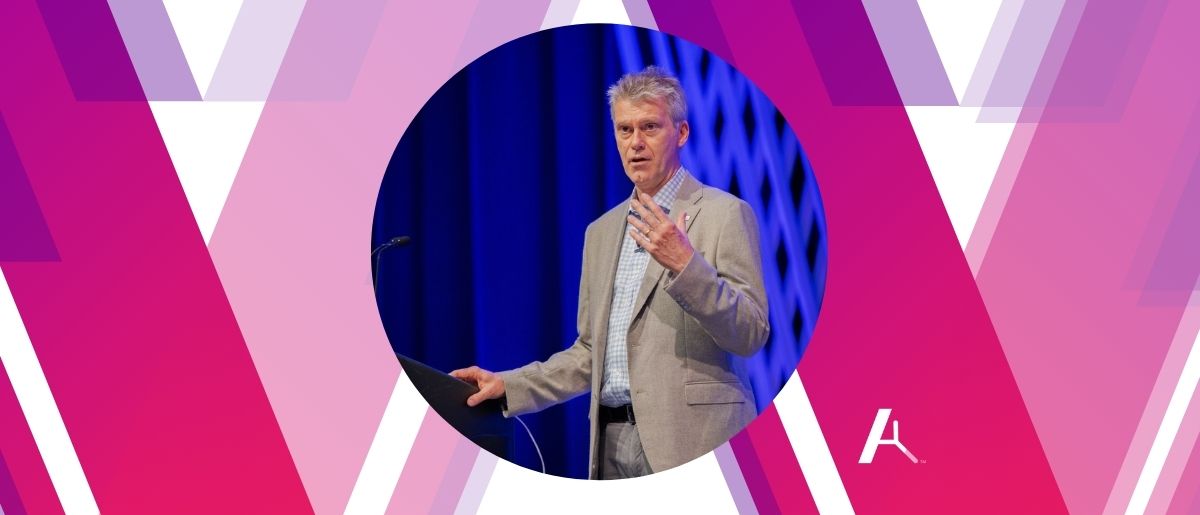
In his President’s Address at IMMUNOLOGY2014™ in Pittsburgh, Jenkins described his career as “trying to understand how CD4+ T cells, the ones that use α–β TCRs to recognize peptides bound to MHC class II (MHCII) molecules, respond during the immune response.” As further discoveries build on his early research, he remains excited. “I never dreamed as I was measuring swollen mouse ears and culturing T cells in 96-well plates that someday my colleagues would be tracking the fates of single epitope-specific T cells during an immune response. What a thrill.”
Jenkins recognized in his President’s Message that immunologists may often feel powerless in the face of an underfunded scientific endeavor, but that “AAI is the organization through which we can funnel our energies to advocate change in the system.”
Kevin Urdahl, one of the very first graduate students in the Jenkins lab, said that “Marc should be remembered as a scientific purist who passionately pursued research with a goal of understanding lymphocyte biology. His work has fundamentally changed our understanding of T cell and B cell biology, and shaped the ways that immunologists do research. The understanding generated from Marc’s research has also transformed medical practice, especially in the treatment of cancer, and saved many lives.”
Urdahl and several other alumni of Dr. Jenkins’ laboratory generously shared their experiences and memories of their time working with him.
Kevin B. Urdahl, MD, PhD (defended 1993)
Professor, Pediatrics, Seattle Children’s Research Institute
Adjunct Professor, Immunology, University of Washington
When I first walked into Marc’s lab as a young MD/PhD student to talk to him about potentially doing a rotation in his lab, he was a newly-minted Assistant Professor. He was 29 years old and already had 2 R01s. Marc treated me as a colleague and an equal from the moment I walked into the lab, even as a first-year grad student who knew little. He instilled self-confidence and taught me to trust my ideas. He taught me to take chances and to strive to do impactful science.
As a lab we were totally immersed in trying to understand the signals required for CD4 T cells to be activated, and also the signals required for T cells to be selected in the thymus. One day I came up with a hypothesis about how positive and negative selection in the thymus might result from different costimulatory signals that the developing thymocyte received. Marc got really excited about the idea and drew it out on his whiteboard so we could think about it and think about how we could test the idea.
He said to me, “Kevin, that is a new idea that nobody else in history has ever thought of. How does that feel? How does that feel?”
Well, it felt pretty good. The hypothesis turned out to not be true, as so is often the case for hypotheses, but that is not really the point. The point is that Marc made a boy from small-town North Dakota believe that he could have a new idea that could be impactful and make a difference. That is a belief that has shaped how I have tried to do science for my entire career. It has spurred me to take risks and to strive to do work that is impactful.
Marc’s primary goal was always to pursue understanding. He believed translation would follow in ways that would be unpredictable before understanding was achieved. Marc’s impact on the immunology field will extend years into the future due to his lifelong dedication to education and mentorship.
R. Lee Reinhardt, PhD (defended 2002)
Professor, Theodore and Maxine Murnick Family Department of Immunology and Genomic Medicine, National Jewish Health
Marc is a giant. He was one of the most influential people in my life.
I came into graduate school never having taken any immunology. I was excited at the time to become a virologist. My first rotation was in a virology lab, and I decided to do my next two in cancer biology and immunology just to get experience in those fields. Marc was the first immunologist to answer my email. He told me he wasn’t taking a student but if I just wanted to learn some immunology I could rotate.
Because I had already found a virology lab I liked (and frankly Marc intimidated the heck out of me as a young student), that sounded perfect. I loved the rotation and his lab members. The experience made me realize that it was the body’s response to infection, not the pathogen itself, that excited me. His lab showed me I was an immunologist at heart well before I knew it myself. For some reason he changed his mind and decided to offer me a spot. I accepted. I really don’t know where I would be had a decided differently.
Marc reminded me of some of the best coaches I had growing up. He was intense, direct, tough, a great teacher and extremely fair. He was interested in us understanding why we were doing what we were doing, and it was important to him that we learned how to do things the right way. He taught us to think critically, made sure we were technically sound (both in ideas and the lab), and gave us the space and independence to fail.
This was important as it made us unafraid of the many challenges and obstacles that are always present when you are trying to be push the unknown. He basically set us up with all the tools to be successful. Then, if we worked hard and had the passion, we would be. The flip was also true. We all wanted him to be successful. We would have run through walls to make that happen.
His trainees are his most important legacy. I bet if you asked him, he would say this too. We mattered to him. Second, scientifically, if you look through the decades, his work was always innovative, technical, and very impactful. However, at the heart of it, Marc talked a lot about “visualizing immunity”. His work made it easy for all of us to see how the immune response actually worked. Seeing is believing. He made the complicated simple. I think that will be his legacy.
Stephen McSorley PhD (fellowship 1997–2002)
Professor, Deprtment of Anatomy, Physiology, & Cell Biology; Veterinary Medicine, University of California Davis
Joining the Jenkins lab was a great experience. It was a great time to join in 1997 because the lab was full of excitement over the “new” adoptive transfer system and how it could be applied to different aspects of T cell biology. Marc was incredibly demanding and expected us to work independently and produce high-quality data and think deeply about our projects.
It was the perfect place for me at the time as I wanted to explore my own ideas about CD4 T cell responses to Salmonella, but I still needed lot of guidance and oversight, even though I probably thought I didn’t.
As a mentor, Marc had very high standards and at that time didn’t suffer fools gladly (he has mellowed with age!). But he was also very generous with his time and intellect, often giving key direction to projects when one of us got a little lost in the weeds.
One endearing trait is that he also publicly apologized to the lab regularly when he happened to overstep the mark and be too critical or demanding the previous day. This is a rare trait for a PI and one that reflects well on him as a human being, one that I greatly admired at the time, and I still do.
He was very “hands off” and let you direct your own experiments. But he took seriously the charge to train his staff and we all had to suffer through “summer school” every year as he made us read and discuss foundational papers in our field. At the time, he would always tell us that being a post-doc is “the best time of your career” which to me seemed like an odd statement since we were working long hours, trying hard to publish papers, climb the career ladder, and most of us were trying to juggle having little kids at home too.
In retrospect, he was 100% correct. It was one of the most exciting and rewarding periods of my career and I look back on it all fondly.
I remember when I wrote the first draft of my first paper on my project and I gave Marc a copy (paper!). It landed back on my desk the next day absolutely covered in red pen, correcting all my typos and shortening every sentence to conform to Marc’s succinct style. I was a little deflated seeing all these corrections until Marc wandered into the lab and enthusiastically declared that this was the “best first draft of a paper” he had read! This typifies Marc’s style; unrelenting high standards, but combined with genuine excitement, enthusiasm, and praise when someone did well. It’s such a great combination to have in a boss.
Marc has made so many important contributions, both technical and conceptual, that have helped the field move forward. You could pick his singular contributions to understanding T cell second signals and tolerance, the adoptive transfer and tetramer innovations, or his desire to always place cellular immunology in a correct anatomical context. But for those who trained with him, his real legacy is his exemplary mentorship and his desire for all of us to be the best scientists we could possibly be. His AAI award for mentorship is richly deserved.
Traci Zell, PhD (Fellowship 1997–2003)
Director, Research & Development, Tonbo Biosciences
Marc’s enthusiasm for science is virtually boundless, he has an amazing ability to synthesize information quickly, and he worked tirelessly to provide funding that supported some rather expensive projects undertaken in the lab – all of which provided a superb environment for his trainees. He would also redline all of the superlative adjectives in the previous sentence, but I think they are necessary in this case.
I was very interested and excited by the in vivo models being developed in Marc’s lab that would enable a more accurate representation of an immunological response than the in vitro assays I used as a graduate student.
It was always highly entertaining during the Christmas/New Year’s break when Marc would decide on a project and became a bench scientist again and worked on a project in the lab every day. Finally, I always respected Marc’s candor—he is a man of very little bulls***.
I believe Marc’s legacy in the field will be a career that focused always on developing systems/models that moved our knowledge forward from ‘what could possibly be happening’ to ‘what is actually happening’ during an immune response.
Antonio J. Pagán, PhD (defended 2012)
Esther Ehrman Lazard Faculty Scholar & Assistant Professor, Department of Microbiology & Immunology, Stanford University School of Medicine
Training with Marc has had a profoundly positive impact on how I approach immunological questions experimentally. Marc has a knack for distilling scientific problems to their essence and for designing simple, well controlled experiments that could distinguish between competing immunological models. He referred to this as ‘cornering the problem’. This is an elegant experimental framework because there are no ‘negative results’ in the traditional sense as each predicted outcome would lend support to a specific model.
I believe that this ethos of ‘cornering the problem’ played an integral role in the development of highly sensitive methods of tracking antigen-specific lymphocytes, such as adoptive transfer and magnetic bead-based enrichment methods, because it allowed us to directly see (and count) numerically rare populations of cells that were previously difficult to detect. These technological advances meant that previously intractable immunological problems could now be ‘cornered’.