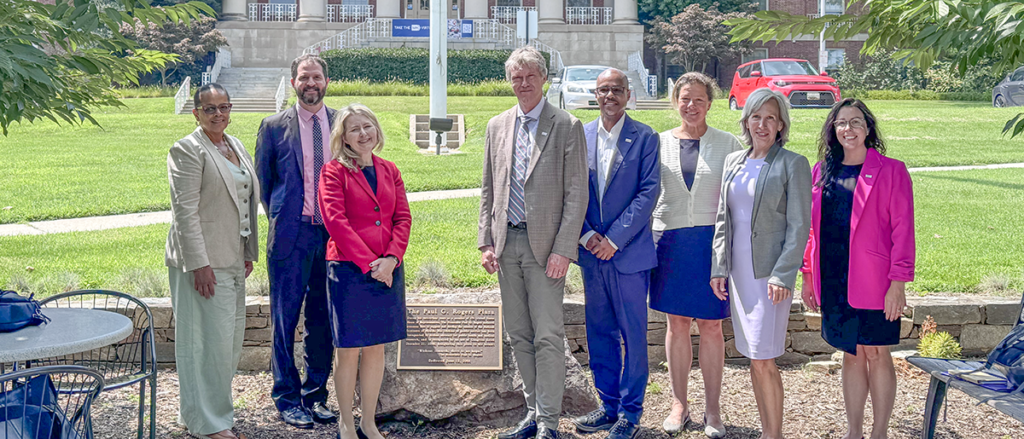
On August 12, select AAI leaders and staff spent the day on the NIH campus in Bethesda, Maryland, meeting with key officials from NIH Institutes, Centers, and Offices (ICOs) to discuss shared priorities, issues of concern, and opportunities for AAI to help advance both NIH-wide objectives and individual ICO missions.
Several key themes emerged during the discussions:
Peer review and scientific merit remain central to funding decisions
NIH senior officials emphasized that peer review and scientific merit continue to be a core factor in funding decisions. NIH leaders argued that the Unified Funding Strategy is an improvement on paylines because it considers the full peer review assessment rather than relying on rigid score-based cutoffs. Additional factors, such as whether a proposal addresses a critical research gap, aligns with agency priorities, or contributes to a broader geographic distribution of funding, are intended to ensure a comprehensive evaluation of scientifically meritorious proposals.
AAI stressed the importance of transparency in funding decisions and clear communication with the extramural community. On August 14, NIH held a webinar on the Unified Funding Strategy to help address some of the community’s concerns.
NIH remains committed to supporting early-stage investigators
NIH officials reaffirmed their commitment to supporting early-stage investigators. Key elements of the Unified Funding Strategy are designed to support a diverse range of researchers, foster innovation, and address priority research gaps across the agency. AAI underscored the importance of recruiting and retaining early-career scientists and maintaining a strong, sustainable biomedical research workforce to ensure continued scientific advancement.
In the absence of special paylines for new and early-stage investigators, AAI plans to closely monitor NIH funding awarded to these groups in fiscal year (FY) 2026 to determine whether NIH continues to properly prioritize them in funding decisions.
Animal models remain essential to biomedical research
NIH officials noted that recent policy shifts should not be interpreted as a deemphasis on animal models. Rather, they reflect an increasing emphasis on consideration of new approach methodologies (NAMs) and selecting the model system most appropriate for addressing the scientific question. AAI stressed that while NAMs are valuable complementary tools, they cannot replace animal models, which remain critical for advancing mechanistic understanding of biology and disease, particularly in immunology research.
Shortly before AAI’s meeting, the National Cancer Institute issued new “Guidance on Applications for Studies with Animal Models.” The guidance requires NCI grantees to include an “explicit justification of the use of animal models and why are alternatives are inferior. This justification [1-2 sentences] must be included in the application’s Abstract section.” While other ICOs have not issued similar policies to date, it is clear from AAI’s conversations that other NIH entities will likely be unveiling similar policies in the near future.
NIH Highlighted Topics signal agency research priorities
NIH officials encouraged investigators to regularly review the agency’s Highlighted Topics webpage, noting that it is now the best resource for identifying emerging research priorities and areas where NIH is seeking to fill critical research gaps. The topics provide valuable insight into current areas of interest across the agency and can help researchers better understand how their work aligns with evolving NIH priorities. The Highlighted Topics page is an especially important tool in understanding NIH’s priorities now that NIH has phased out Notices of Special Interest and dramatically scaled back its use of Notices of Funding Opportunities.
AAI also relayed concerns about the increased use of multi-year funding to support new awards, delays in the issuance of research awards, and the lack of clarity and sense of uncertainty felt by the scientific community about many new NIH policies, how they will be implemented, and what their long-term effects on the scientific enterprise will be.
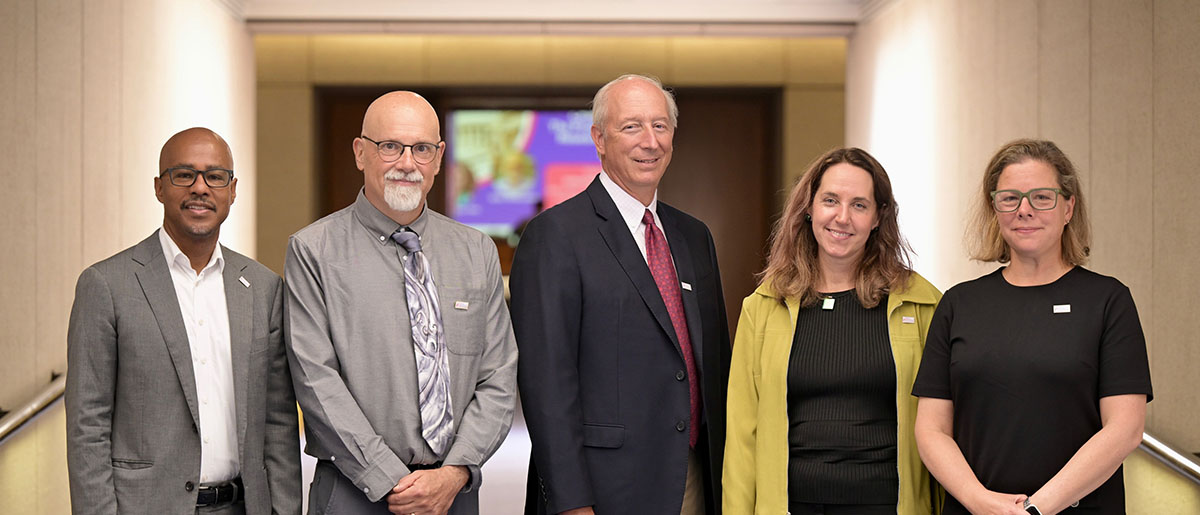
During the visit, AAI met with senior officials and staff from the NIH Office of the Director, the National Institute on Aging, the National Cancer Institute, and the Office of Autoimmune Disease Research.
AAI participants included AAI President Avery August, PhD; Past President Ulrich von Andrian, MD; Advocacy and Policy Core Committee Chair Marion Pepper, PhD; Chief Executive Officer Loretta Doan, PhD; AAI Chief Membership & Engagement Officer Gwen Fortune-Blakely, MBA, CAE; Director of Government Affairs Jake Schumacher; and Senior Science Policy Analyst Emily Kansler, PhD.