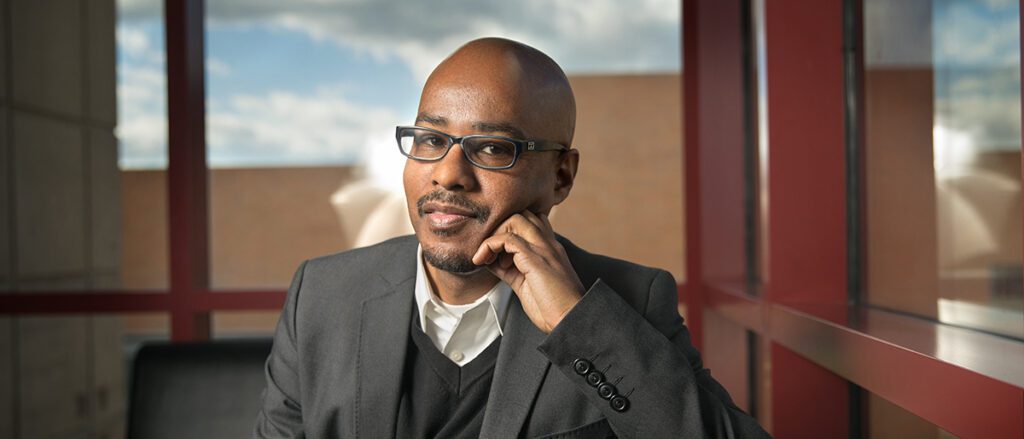
Avery August, PhD, is now the 109th president of the American Association of Immunologists, and the first scientist from an under-represented minority to lead the organization. He takes the role at a time when the field faces many unprecedented challenges, but his experience on the AAI Council since 2021 has given him a well-informed perspective.
Dr. August acknowledges that when he initially ran for AAI Council, “we were in a very different space. The presidency has evolved into a different type of leadership. But there are some things that are probably timeless.” Read his President’s Message to discover his priorities for the association.
We spoke with Dr. August about his vision for the coming year.
From Belize to Cornell
Dr. August was born and raised in Belize. After high school, he attended Belize Technical College (now part of the University of Belize) for one year before his family immigrated to Los Angeles. He completed his bachelor’s degree at California State University, Los Angeles, and earned his PhD at Weill Cornell Graduate School of Medical Sciences under Dr. Bo DuPont.
After a post-doctoral fellowship in the laboratory of Dr. Hidesaburo Hanafusa at the Rockefeller University, August joined the faculty of Pennsylvania State University. In 2010, he moved to the Cornell University College of Veterinary Medicine. There, he is a Howard Hughes Medical institute Professor of Immunology and Deputy Provost.
Advances on the Horizon
Dr. August is excited by where the field is heading now, both for immunology and other sciences impacted by immunological discoveries, especially the promise for using immune cells such as CAR-T cells to “fine-tune an immune response, whether we want to enhance an immune response or to suppress an immune response. That has implications for a wide range of therapies, in chronic disease, autoimmune disease, infectious disease in some cases.”
These advances, Dr. August believes, will become even sharper as AI and other informatics techniques allow scientists to integrate much more data to uncover novel pathways.
Another exciting development, says Dr. August, is the ability to use the “structural underpinnings of immunology: understanding both T cell development and T cell differentiation not just to use cells as therapies, but to go into those cells with small molecules and reshape the immune response.”
Dr. August pointed to recent clinical trials in which small molecules hit particular targets like BTK (Bruton’s tyrosine kinase), to reshape immune responses in a way that was not possible in the past.
New Generations of Biologics and Immunotherapies
Dr. August looks forward to new generations of biologics. “You know, they’re advertised all the time on TV, but there will be second and third generations of biologics that will be even more selective, tuning the immune system to impact immune response.”
Recent advances in targeting signaling pathways show the promise of expanding immunotherapies well beyond cancer. “Cancer is usually the low hanging fruit, because generally patients don’t have many options. So they’ll take therapies that perhaps have some toxicity associated with them. But we’re getting a sense of what targeting those pathways can be like if we do them in other types of disease, and the next level of diseases are going to be the chronic, the immune diseases, and so on.”
Bringing Transfer Students into the Fold
At Cornell, Dr. August established a Research Transfer program through the Howard Hughes Medical Institute to assist transfer students from community colleges. As a one-time transfer student himself, recognized the importance of diversifying the population that gets to participate in science. He says that when you ask scientists if they were transfer students, “people put their hands up, right? But they’ve progressed in spite of not having access to the things available to our colleagues who don’t go through community colleges.” He wants to put a spotlight on this group of upcoming scientists and say, “There’s talent over here as well, and we should be thinking about that.”
International Perspectives on Immunology
Dr. August has long been involved in international research cooperation and hopes to see greater AAI involvement among immunologists from under-represented nations. “Think of a country like Brazil where immunology plays out in a very different way. It’s much more applied, it’s much more focused on local issues like parasitic infections. Some of the first immunological therapies came out of Cuba as a low-income country, because they homed in on how to make the best antibodies to treat cancer, and because the Cuban government set up an institute where they train their scientists to do it.”
AAI should be thinking about “how we engage individuals in those low and middle income countries to think of themselves as immunologists, even if they only work on antibodies in a very applied way, or only because they have to, by necessity, focus on their local context.”
Dr. August has direct experience in this sort of international cooperation. He was brought in by the Indian Government to help develop a series of short courses in immunology for their colleges. “I built a two-week course where we laid out things like how to do an ELISA, how to do a Western blot, how to analyze immune genes. These are the fundamentals that we assume everyone is aware of here in the US and in high income countries. But that’s the infrastructure that still needs to be built in those countries.”
DJ T Cell?
In his limited free time outside the lab and AAI leadership, Dr. August unwinds with some electronic music. But he doesn’t just listen; he mixes his own personal set. “I generally don’t play for others. I’m not in the club or anything like that! I call it wasabi for the mind. I’ll go in and I’ll do a set and, three or four hours later, I’m so engrossed in what the set looks like that it sort of resets me.”
Asked if he would consider playing a set at IMMUNOLOGY2027™, Dr. August smiled and politely declined, saying “I don’t think that’s one of the duties of the AAI president.”