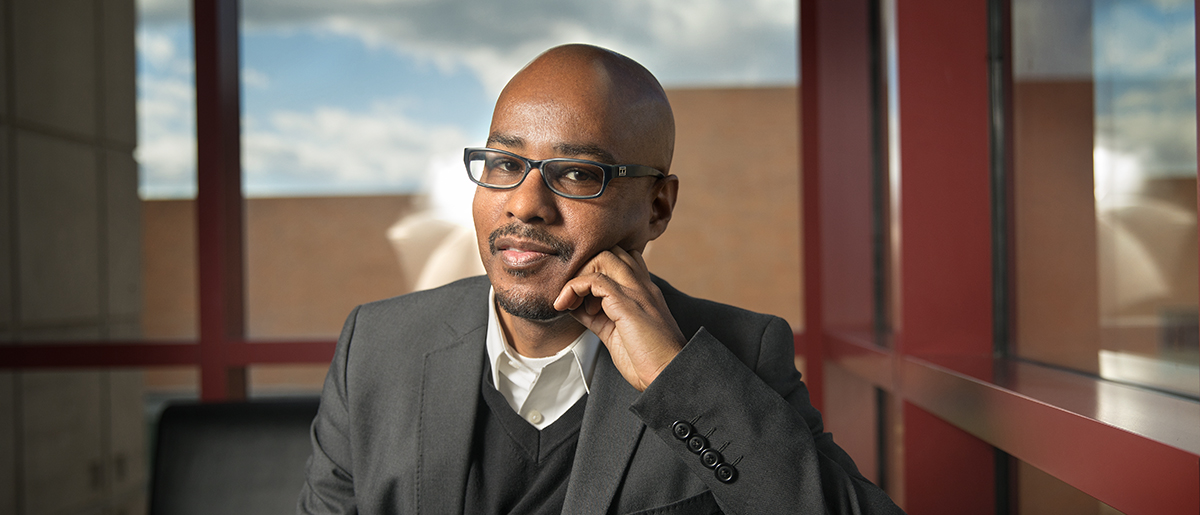
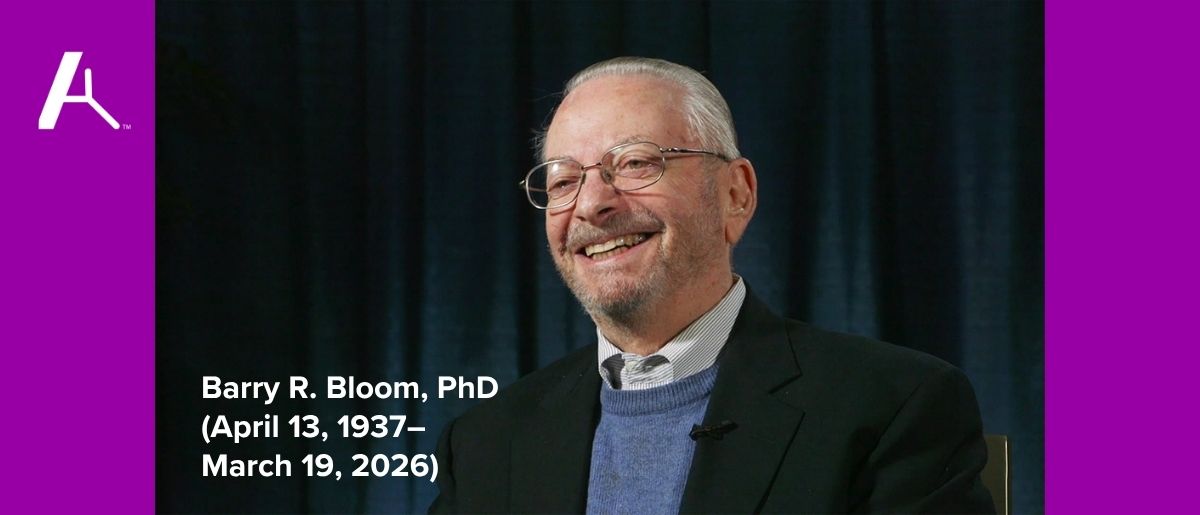
Former AAI President and Distinguished Fellow Barry R. Bloom, PhD, has passed away after a long battle with cancer. He was the emeritus Joan L. and Julius H. Jacobson Professor of Public Health, in the Department of Immunology and Infectious Diseases of the Harvard T.H. Chan School of Public Health. Dr. Bloom was renowned for his basic research on immune function and response to infectious diseases, as well as his global public health work.
In 2029, Dr. Bloom sat down with AAI for a fascinating and wide-ranging oral history interview. Selections are included below; you may also read the whole interview or watch the video.
Discovering A Passion and Purpose
Bloom: My background is pretty much undistinguished other than the fact that everybody in my family, all my uncles and one aunt, were physicians, so it was expected from the day I was born that I was going to be a doctor…. In a bolt of adolescent rebellion, I decided not to go to medical school, although I had applied and was admitted, and Rockefeller University had started a new immunology program as a graduate university, and this is what I wanted to do.
One of the attractions was…one introductory course, which was one Nobel laureate after another talking about theoretical physics, quantum physics, everything you could think of, much of which we didn’t understand, but we were impressed by the personalities.
Embarking on an Academic Career
I had an idea of what I wanted to do…. There’s lymphocytes—in those days, we didn’t have T cells—and there were macrophages, and the question that was raging was which cell had specificity for antigen. My colleague Boyce Bennett spent hours with me working on how to separate cells, and what we showed is that it was lymphocytes, not macrophages, that had the specificity for antigen.
And when we showed that it was the lymphocytes that were inhibiting macrophages, and we showed that as few as a half percent of immune lymphocytes would inhibit the migration of the remainder of normal macrophages, we figured out they must be making something and secreting it…. We called it migration inhibitory factor, and that was really the first of the lymphokines that had been discovered and the first nonantibody product of lymphocytes that had been described in the literature.
So that’s how I got started in the business of cell-mediated immunity, a long series of failures, and for reasons not clear, I somehow lucked out at the end.
Introduction to Global Health
The result of the paper on the lymphokines’ migration inhibitory factor led to a totally unexpected invitation….After we published the Science paper on cytokines and which cell had specificity for antigens, I got an invitation from the World Health Organization (WHO) to come to Geneva to explain my work.
Later, WHO officials arranged a meeting in New Delhi for the following year, and there were three outsiders. One had discovered a colony-stimulating factor, which has had a great power in medicine and in the pharmaceutical industry; one discovered that there was a relationship between sickle cell and malaria; and I was the third of that group. Also there were a series of Indian leprologists, and it was all overseen by a young Norwegian named Tore Godal, who later became head of the Special Programme on Tropical Diseases at WHO and the first director of Gavi [Global Alliance for Vaccines and Immunization]. It was an extraordinary meeting.
Leprosy
We knew nothing about leprosy and leprologists knew nothing about basic immunology, and the number of questions we could ask was extraordinary. [And these questions] would be easier to answer in leprosy than almost any other condition. We can’t study easily what goes on in the human lung. It’s very difficult. But leprosy’s a skin disease. It rarely disseminates internally, probably because it doesn’t grow at high temperatures, and skin is at a lower temperature, about 32 to 34 degrees centigrade.
The second striking thing about this odd disease is that it isn’t a single clinical entity; it’s a spectrum that correlates perfectly with the immunology. At one end of the spectrum, lepromatous leprosy, the bugs flourish. They grow essentially only in macrophages or Schwann cells around the nerves and they cause nerve damage. At the other end of the pole, there’s a massive infiltration of what we would now see as CD4, CD8, and macrophages, and almost no visible bacilli. The macrophages kill off the bacilli, but in the process, they damage the nerves as well.
Inspiration for Further Study
As a consequence, it was an extraordinary, unique opportunity to study the whole range of cellular immune responses from unresponsiveness to too much responsiveness in the context of a human disease. So I have spent a good part of the rest of my life studying immune responses in leprosy, and it has remained, at least for me, a rewarding subject.
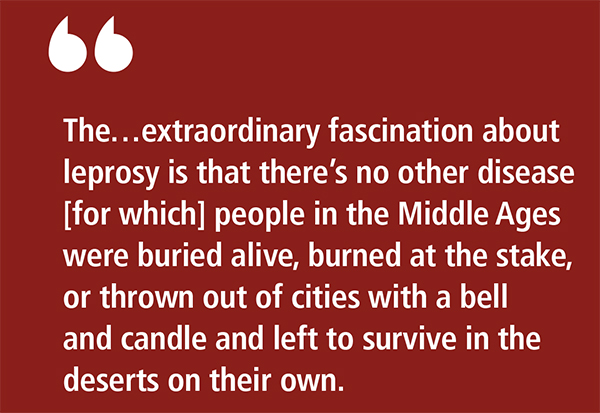
The other extraordinary fascination about leprosy is that there’s no other disease [for which] people in the Middle Ages were buried alive, burned at the stake, or thrown out of cities with a bell and candle and left to survive in the deserts on their own. It not only has a history but it has a stigma, and that led me to believe that, yes, I wanted to do basic science, but not just to write papers in Science, Cell, and Nature; I wanted to do basic science on real diseases with real pathogens, and at the time I started, nobody, or virtually nobody, worked on real antigens.
The Diverse and Exciting Field of Immunology
Where can you get a field where you can study fundamental immune responses, regulation of a really complicated system? The dean at Albert Einstein when I was there was a neuroanatomist, and he liked to say to students, who always roared at this, that the brain is the second-most important organ of the body, and he never specified what the other organ was. For me, it was always the immune system and lymphoid system, even more complicated, probably, than the brain. The ability to recognize almost any compound, any chemical in the environment that it’s never seen before and make a response to it, that’s astonishing.
And then to be able to go from very basic mechanisms, from DNA and RNA and all that, to how do you develop a vaccine or a diagnostic that’s going to make a difference in the world, I mean, [in] how many fields can one investigator have the freedom to find their niche in any part of a giant scientific spectrum? So it remains even more exciting now than it was when I was a student.
Dr. Bloom’s colleagues are preparing a celebration of his life. Details will be announced when available.