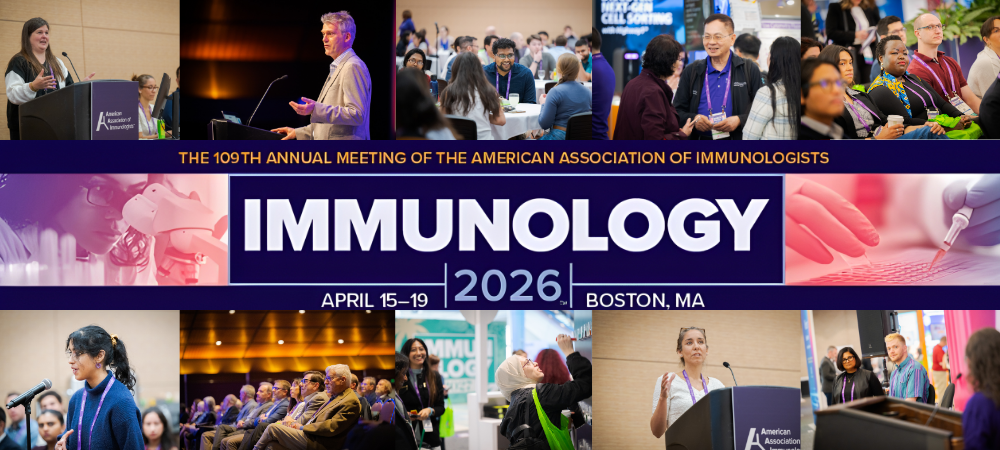
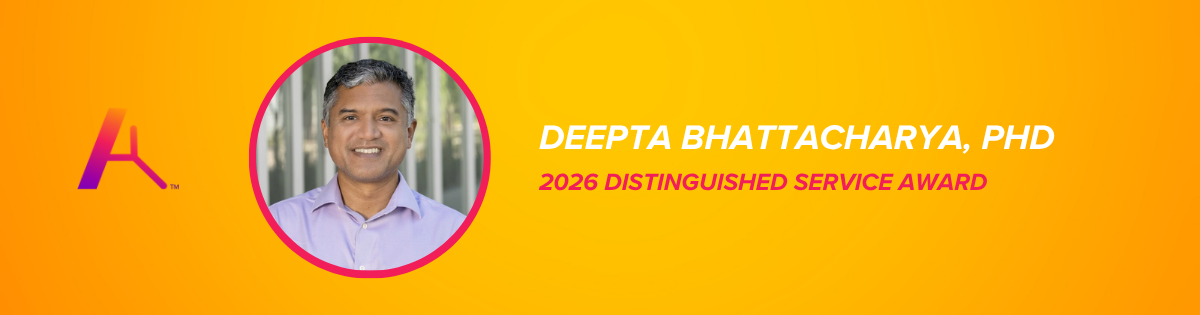
At IMMUNOLOGY2026™, Deepta Bhattacharya, PhD, was awarded the Distinguished Service Award (DSA) for outstanding service as the inaugural chair of the AAI Public Communications Committee (2022-2024). Formed in the Fall of 2021, the AAI Public Communications Committee (PCC) directs AAI’s public communications to raise awareness of immunology and establish AAI as a trusted source of information.
AAI News & Views spoke with Dr. Bhattacharya about his service to AAI and his experience in science communications.
What excited you about being the first chair of the Public Communications Committee? What challenges in public communications did you hope to address?
When I took the chair position, I knew that I was getting the opportunity to work with an engaged group of people who were passionate about sci-comm and AAI. As we got started, we recognized that we needed to decide on some key issues: What are we trying to achieve? Who is our target audience? How do we most effectively deliver the message?
We recognized first and foremost that AAI as an organization is focused on fundamental immunology research, and that there is a gap in communicating science to the public at that level. There are public health sites that turn up in internet searches for diseases, but there is very little out there for people who want a closer look under the hood to understand how things normally work and what goes wrong in disease. We saw this gap as an opportunity to explain the basic science in an understandable way, show how this fundamental work explains the basis of specific diseases, lay out how this knowledge leads to targeted treatments, and provide forward-looking perspectives on ongoing research. Based on this, we came up with Immunology Explained to introduce the public to AAI as a credible source of information and to make the case for basic science.
The PCC was founded partly as a response to the COVID-19 pandemic. How has your perspective on public communications changed since then and are the priorities different?
During the COVID-19 pandemic, suddenly, the work of immunologists became of great public interest. I can safely say that I never thought I would be discussing germinal center persistence with New York Times reporters!
The interests of the public are different now than they were at the height of the pandemic. However, I think some of the lessons from the pandemic still apply, especially as we are in an era where disinformation comes from every angle, all the time. I once gave a public talk where I showed the Kaplan-Meier curves of efficacy from Moderna’s COVID-19 vaccine trial. Afterwards, one of the audience members introduced herself as someone who was initially vaccine-hesitant but was persuaded by the data and wondered why no one had ever shown it to her before. For some people, it isn’t enough to repeat the mantra that a given vaccine is safe and effective. To buffer against disinformation, we need to explain how we know vaccines are safe and effective. Like this audience member, those who are interested and open-minded are who we should be trying to reach.
What advice do you have for scientists looking to increase their public communications?
If you don’t know where to start, there are training programs that can get you going, such as ENGAGE and the Alan Alda Center. However, you can begin just by getting in the habit of talking science (either your own work or cool new things you read about) to people outside your field and to your non-scientist friends and family. It doesn’t have to be about hot-button issues or advocacy to start—sharing your enthusiasm for science without an agenda can build trust that becomes important later.
Pay attention to what works and what doesn’t and adjust accordingly. All of this will help you gain an instinct of how to calibrate what you say and how you say it. With these skills, you can, for example, productively use forums like social media to talk about science, which in turn may pique the interests of science and health reporters. You might also consider joining the AAI Public Communications Committee!
What does receiving this award mean to you?
I’m deeply honored and proud of what the PCC has accomplished. I was just one member of the committee, so I see this honor as recognition of the whole PCC and the work that they do.
Dr. Bhattacharya is the Inaugural Executive Director of the Center for Advanced Molecular and Immunological Therapies and Professor of Immunobiology at the University of Arizona College of Medicine.
To learn more about the AAI’s public communications efforts, visit ImmunologyExplained.org.