
A Game-Based Strategy to Build Conceptual Understanding and Communication Skills in Immunology

This article is part of the AAI Teaching Tools series. More articles can be found in the Teaching Tools section. Archived articles can be found on the AAI website.
by Rebecca Clements, PhD
Assistant Professor of Biology, Kenyon College
Immunology is a conceptually rich discipline, but it is also dense with specialized terminology that can sometimes hinder understanding of this subject. Students often learn to recognize and recall immunological terms without developing the ability to clearly explain the underlying mechanisms, particularly in spoken contexts. This limitation becomes apparent during discussions and oral assessments, where students often rely on circular definitions or jargon-heavy explanations that mask incomplete understanding.
To address this challenge, I employ a classroom activity based on the Hasbro party game Taboo that encourages students to describe immunological concepts without relying on memorized phrasing.
Gamification of Exam Prep
BIOL 345: Immunology is a twelve-student upper-level elective taught at Kenyon College, a small liberal arts institution in rural Ohio. This undergraduate course emphasizes both conceptual understanding and the ability to communicate complex biological processes clearly. As part of this emphasis, students complete an oral exam in which they are asked to explain immunological processes and mechanisms in their own words. To help students prepare for this assessment, we play “Immunology Taboo” as a low-stakes, high-engagement way to practice clear and accurate scientific communication.
In this activity, students are divided into two teams (B cells and T cells). In my experience, teams of approximately 4–6 students are ideal because they allow all students to participate regularly while maintaining the pace and energy of the game. During each round, one student from the active team serves as the clue-giver while the remaining teammates act as guessers. Students on the opposing team rotate through the roles of referee, timekeeper, and scorekeeper before switching responsibilities in later rounds.
Don’t Say the Taboo Words!
Each clue-giver receives a card containing an immunological term along with a list of “taboo” words representing the most obvious or commonly used descriptors. The goal is to lead teammates to correctly guess the term without using any of the forbidden words. For example, when describing “opsonization,” students might be restricted from using terms such as “antibody” or “complement,” requiring them instead to rely on deeper understanding and creative explanations in order to succeed. Each round lasts 90 seconds, and teams earn points for correctly guessed terms. Students rotate roles so that all participants practice both explaining and interpreting clues.
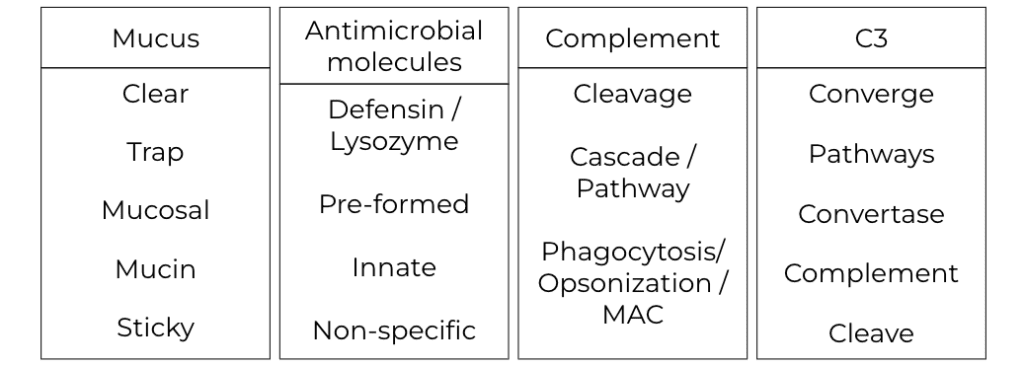
To maintain the emphasis on conceptual understanding, students are not allowed to use rhyming clues, abbreviations, first-letter hints, gestures, or “sounds like” prompts. Instead, clues must rely on mechanistic explanations, biological functions, or conceptual relationships. When disagreements arise regarding whether a clue is acceptable, the referee and instructor make a quick ruling so that gameplay continues smoothly and the activity remains collaborative and low stakes. When making these decisions, I generally prioritize whether a clue conveys meaningful conceptual information rather than whether it technically skirts the rules, as the primary goal of the activity is to encourage clear mechanistic explanation rather than competition over loopholes.
Benefits of the Game
This structure pushes students beyond rote memorization and encourages them to engage more deeply with the material. By removing access to familiar terminology, the activity requires students to think critically about mechanisms and relationships, translating technical language into clear, functional explanations. It also provides immediate feedback: when a team struggles to guess a term, it often reveals gaps in the clue-giver’s conceptual understanding. At the same time, the game format fosters a collaborative and energetic classroom environment that lowers the stakes of participation and encourages broader engagement.
I have observed several consistent benefits from implementing this activity. Students become more comfortable speaking about complex topics and demonstrate increased fluency and precision in their explanations over time. During oral exams, they are less likely to rely on memorized phrases and more likely to construct coherent, mechanistic descriptions. Additionally, students report that the activity helps them identify areas where their understanding is incomplete, allowing them to focus their studying more effectively. The combination of play and accountability appears to make challenging material more approachable while reinforcing essential communication skills.
Adaptable to Different Educational Levels
Although designed for an upper-level undergraduate course, Immunology Taboo is highly adaptable. Instructors can modify the complexity of terms and taboo words to suit introductory, graduate, or professional-level courses. The format is flexible enough to accommodate a range of class sizes and requires minimal preparation once a set of cards has been developed. As such, it offers an accessible way for instructors to incorporate active learning and oral communication practice into their teaching.
By combining active learning with playful competition, Immunology Taboo provides a versatile approach that instructors can bring back to their own classrooms to improve student learning and engagement.
A printable and fully modifiable example card deck and rules for the game can be found online.
Acknowledgments
I thank the students of BIOL 345 for their enthusiasm and willingness to engage with this activity, as well as colleagues who have provided feedback on its implementation.