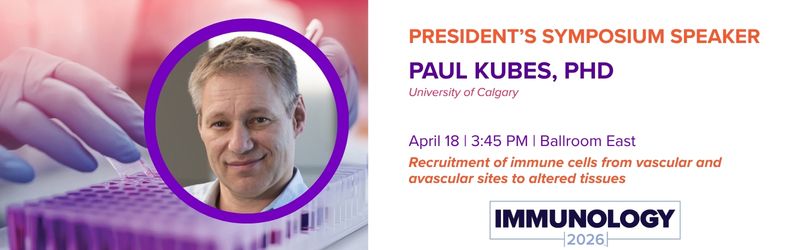
As part of the President’s Symposium on Saturday, April 18, at IMMUNOLOGY2026™, Paul Kubes, PhD, will speak on “Recruitment of immune cells from vascular and avascular sites to altered tissues.” Dr Kubes is a Professor in the Snyder Institute for Chronic Diseases at the University of Calgary.
Dr. Kubes uses cell biology approaches as well as mouse transgenic and knockout technology to delineate molecular mechanisms underlying the recruitment of leukocytes to sites of inflammation. His particular interests have included the multi-step cascade of leukocyte recruitment which includes the proteins responsible for catching leukocytes and tethering them to the endothelium, as well as examining the proteins that contribute to leukocyte migration out of the vasculature.
We spoke with Dr. Kubes about his upcoming President’s Symposium lecture as part of a series of interviews with IMMUNOLOGY2026™ speakers.
How would you describe your lecture to a non-scientist in 30 seconds?
Police cruisers patrol the streets of a city ensuring everything is calm. The immune system is exactly the same, patrolling all organs of the body. Suddenly a call comes in that there is a problem at a bank on 5th street. Many of the police cruisers are mobilized and arrive as quickly as possible, surrounding the area and making sure no one escapes. Similarly, a small injury or infection somewhere in the body must alert the immune system to arrive in a timely fashion and ensure there is no dissemination of the problem to other parts of the body.
I will discuss the information network that alerts and ensures the immune system arrives in a timely fashion to the exact site and then leaves in an orderly fashion. Usually this happens via the blood vessels but sometimes this takes too long and there are alternative routes that can be used to minimize damage and infection.
Why should immunologists know more about the adhesion cascade?
The most fundamental process underlying any immune disease is the migration of immune cells to the afflicted site. Understanding the mechanisms that mediate these events would improve therapy. Probably the best example of why we need to know more about the adhesion cascade relates to CAR T cell immunotherapy. T cells are harvested engineered into tumor killing cells and re-injected into the body with hopes at least a few of them will find the tumor.
However, all too often the T cells either do not find the tumor or go to the wrong place where they cause devastating injury to heart, intestines and other organs. Each T cell has a prescribed address to which it homes and trying to make it go elsewhere will not work.
Another example was the SARS-CoV-2 pandemic where physicians needed to block neutrophil recruitment into lungs. While we know about integrins and selectins as key adhesion molecules for some organs, neither may be involved in neutrophil recruitment into virally infected lungs and so no anti-adhesion therapy was available.
What was the path that led you to the research you are discussing in your talk?
As a PhD student I saw a talk about imaging the immune system in vivo in a model of a heart attack. Immune cells came charging into the injured area. I thought this was the coolest thing I had ever seen and decided to do a postdoc in that area. Thirty five years later I continue to image all the different organs attempting to understand how immune cells reach sites of injury.
What are you looking forward to at IMMUNOLOGY2026™?
Seeing the many talks and posters and talking to my colleagues about new discoveries. Sometimes informal discussions over a beer spark new ideas, new collaborations and break-throughs. Walking away from the meeting with one good idea is well worth the trip.