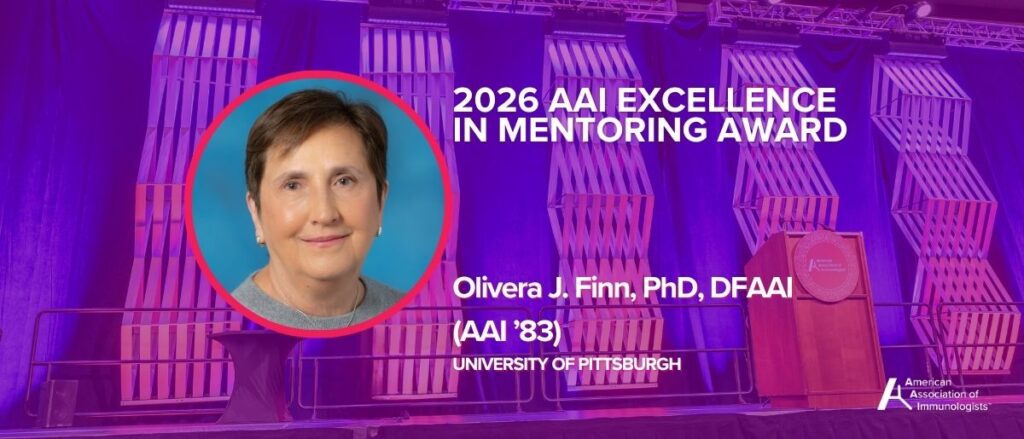
At IMMUNOLOGY2026™, Olivera J. Finn, PhD, DFAAI, will be presented with the 2026 AAI Excellence in Mentoring Award for her exemplary career contributions to a future generation of scientists.
Dr. Finn is a Distinguished Professor in the Departments of Immunology and Surgery at the University of Pittsburgh. She served as AAI President 2007–08, received the AAI Lifetime Achievement Award in 2016, and was elected a Distinguished Fellow of AAI in 2019
Born in the former Yugoslavia, Dr. Finn came to the United States as a newlywed in 1968. Her husband soon joined the Coast Guard, and she went with him to Puerto Rico. She graduated from the Interamerican University of Puerto Rico with a degree in parisitology. The couple then both enrolled in graduate programs at Stanford University, where she earned a PhD in immunology in the lab of Henry Kaplan and completed a post-doctoral fellowship with Ronald Levy (AAI ’77)
In 1982, Finn started at Duke University as an Assistant Professor in the Department of Microbiology and Immunology. Nine years later, she moved to the University of Pittsburgh, where she has remained for the rest of her career. Dr. Finn has mentored numerous students in her long and distinguished career. She spoke with AAI News & Views about her experiences.
What experiences in your career have informed your approach to mentoring?
Finn: The most influential was my own experience with mentors. I learned how important was the mentoring that I received and how even more important was the mentoring that I did not know that I needed and did not receive. My PhD advisor and my postdoctoral advisor guided me successfully in my research, and I benefited from their scientific excellence and peer recognition that positively reflected on me as their trainee.
But as I took my first faculty position and started my first lab, I realized that I lacked training in other important aspects of an academic scientist career, such as grant writing, science communication and networking. So I made sure from the very beginning to mentor my trainees in all aspects of a scientific career, not only lab research.
They participated in grant writing, celebrated the grants that we received and analyzed those we did not; they submitted their own grants and fellowships; they were encouraged to teach and mentor others in the lab; they joined me at important meetings, gave talks and posters and networked with important people; they joined professional societies, primarily AAI, and participated in their various activities; they were co-inventors on invention disclosures and patent applications.
What’s the most important thing a new PI should know about mentoring the trainees in their lab?
Finn: One becomes a good mentor over time. Until then, genuine care for the well-being of the trainee can carry you a long way. Also, as we formulate and hone our personal mentoring styles and goals, it is important to remember that they will be applied to unique individuals with unique potentials and life situations: a recent college graduate new to lab life, a student coming with several years of research experience in academia or industry, a foreign student, a new mother, a main caretaker of a sick parent or a sick child.
Some customization will be needed to successfully mentor all of them to be productive lab members and successful future scientists. Mentoring the whole person rather than a lab member gives best results and builds highly rewarding life-long connections.
This is a challenging time for all scientists, and especially those entering the field. What advice do you have for young people just starting their careers?
Finn: There have been challenging times before and we have met them and overcome them with scientific excellence, persistence and science advocacy. Young people should not be discouraged from following their dreams. Passion for life in science trumps challenges that we, their mentors, know to be temporary.
My advice is to stay true to their professional goals and to enable them by participating actively in science advocacy efforts of their institutions, professional organizations and community networks.