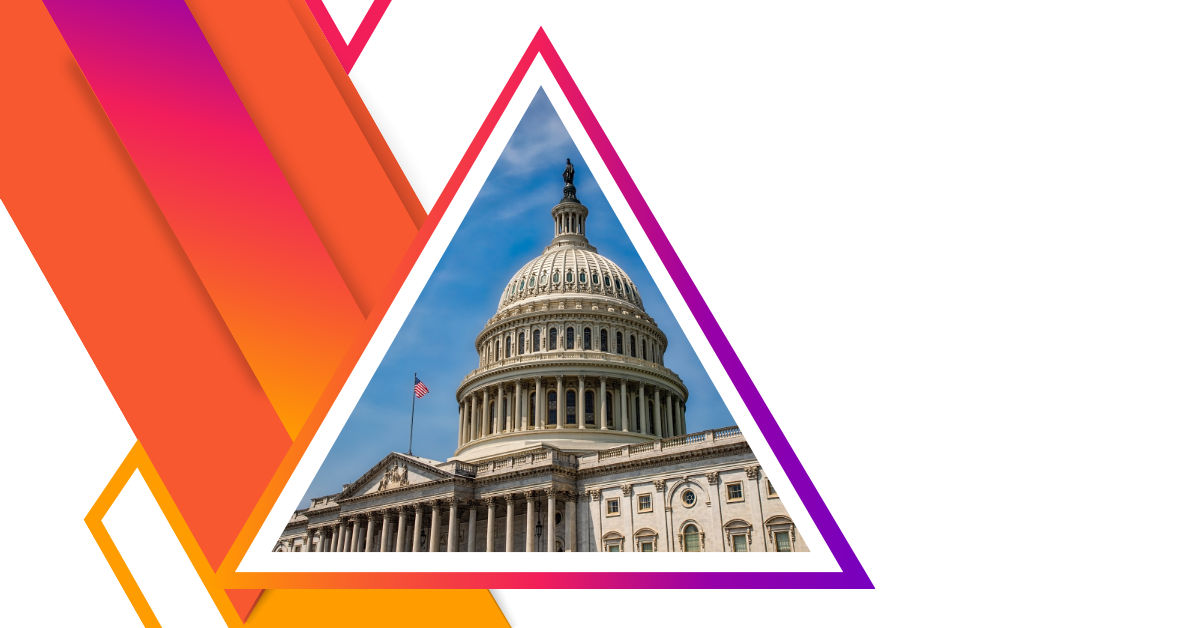
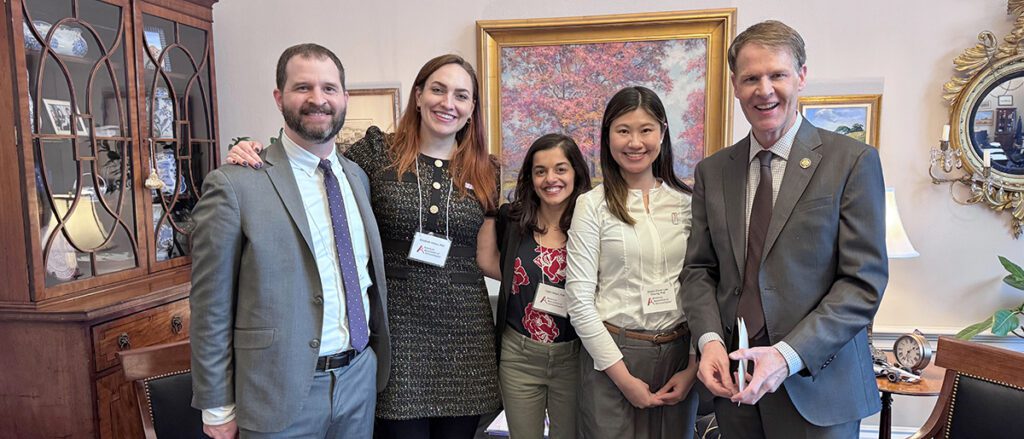
Last week, the 10 participants in the 2025–26 AAI Public Policy Fellows Program (PPFP) traveled to Washington, D.C., to meet with their Members of Congress and communicate the importance of federal funding for immunological and biomedical research. The Fellows, who were joined by two members of the AAI Committee on Public Affairs and AAI staff, met with a total of 25 Congressional offices from eight states.
A Year of Advocacy Training
The Public Policy Fellows—a cohort of early-career immunologists—have been training with AAI since last spring through a series of monthly virtual sessions designed to build their science communication and advocacy knowledge and skills. In addition to preparing for Hill Day, the Fellows were given the opportunity to assist with AAI projects throughout the year, including ensuring that the most impactful immunological breakthroughs are showcased in AAI’s Advocacy Brochure and in its annual Congressional testimony.
The Hill Day was preceded by a training dinner on the evening of March 3, which featured a special guest speaker: Adrienne Hallett of the Coalition for Life Sciences, of which AAI is a proud member organization. Ms. Hallett offered the fellows valuable insight into the current legislative landscape and strategies for effective advocacy conversations with Congressional offices. The Fellows also heard from AAI Director of Government Affairs Jake Schumacher and AAI Senior Science Policy Analyst Emily Kansler, PhD.
Funding recommendations
During Capitol Hill Day, the fellows delivered AAI’s federal funding recommendations for the National Institutes of Health (NIH) for fiscal year (FY) 2027 and described some of the policies that are inhibiting research. Specifically, the Fellows called on Members of Congress to support:
- At least $51.3 billion for NIH for FY 2027
- At least $7.15 billion for the National Institute of Allergy and Infectious Diseases (NIAID) for FY 2027
- Further limiting NIH’s ability to use multi-year funding (MYF; front loading grant funding rather than spreading over 4-5 budget years).
- Increased oversight of NIH to monitor the impact of things like grant terminations, MYF, and the recent elimination of paylines.
The messages were well received in most of the meetings. Congressional staff were incredibly generous with their time and asked thoughtful questions to better understand how the current funding and policy climate is impacting the immunology community.
The AAI PPFP equips early-career scientists with the skills, knowledge, and connections to become effective advocates throughout their careers, and AAI looks forward to working with the members of this year’s class for many years to come.
AAI PPFP Hill Day participants:
- Alfonso Bencomo-Alvarez, PhD, St. Jude Children’s Research Hospital (TN)
- Mayassa Bou-Dargham, PhD, Castle Biosciences (TX)
- Cherry Cheuk Lam Cheung, MSc., PhD (IN)
- Elizabeth Delery, PhD, Indiana Biosciences Research Institute (IN)
- Jordan Holl, PhD, Wadsworth New York State Department of Health (NY)
- Marisa Joldrichsen, PhD, The Ohio State University (OH)
- Ian Saunders, PhD, Johnson & Johnson (PA)
- Allison Seeger, PhD, The University of Texas at Austin (TX)
- Tulika Singh, PhD, University of California, Berkeley (CA)
- Sheetal Verma, PhD, Rutgers University, New Jersey School of Medicine (NJ)
- Lauren Ehrlich, PhD, Chair, AAI Committee on Public Affairs (CPA); L. Leon Campbell, PhD Distinguished Professor in Microbiology, The University of Texas at Austin (TX)
- Peter Morawski PhD, Chair, AAI PPFP Review Committee, AAI CPA; Research Assistant Member, Benaroya Research Institute (WA)