Teaching Human Subjects and Laboratory Research to Undergraduates Through Fully Independent Projects
This article is part of the AAI Teaching Tools series. More articles can be found in the Teaching Tools section. Archived articles can be found on the AAI website.
by Amanda M. Burkhardt, PhD
Titus Family Department of Clinical Pharmacy, Alfred E. Mann School of Pharmacy and Pharmaceutical Sciences, University of Southern California
Trojan Cortisol Assessment and Laboratory Measurement (Trojan CALM) is a longitudinal, human subjects research project investigating perceived and physiological stress within the university population. A unique aspect of Trojan CALM is that the undergraduate students are the sole drivers of the research experience. Each student enrolled in Trojan CALM develops a unique research question focused on a specific subpopulation or lifestyle variable (e.g., sleep, physical activity, extracurricular involvement).
A Student-Driven Process
Students create or amend Institutional Review Board (IRB) protocols, participate in participant consenting and recruitment, and contribute to grant writing efforts to support the project. Participants complete weekly perceived stress surveys, adapted from the Perceived Stress Scale (PSS-10), and provide weekly saliva samples. Undergraduate researchers are trained to collect, handle, and analyze samples using enzyme-linked immunosorbent assays (ELISAs) to quantify salivary cortisol.
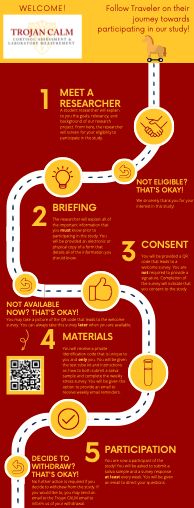
Students independently analyze survey and laboratory data using appropriate statistical methods (e.g., t-tests, ANOVA), interpret their findings, and place results in the context of existing literature. Dissemination is a required component, with students generating recruitment materials (Figure 1), posters, presentations, and manuscripts.
Trojan CALM is implemented through upper-division undergraduate research-for-credit courses and senior honors thesis courses housed in the Alfred E. Mann School of Pharmacy and Pharmaceutical Sciences at the University of Southern California (RXRS or BPSI 490, RXRS or BPSI 493/494). The project has been embedded primarily within independent research courses, which function as elective credits rather than required core coursework. The experience integrates both laboratory and applied research components: students engage in wet-lab experimentation (salivary cortisol ELISAs), human subjects research, survey science, data analysis, and scholarly dissemination. While there is no traditional lecture component, students receive structured mentorship, methodological training, and scientific guidance throughout the semester.
Increased Engagement
From a teaching perspective, Trojan CALM has fundamentally shifted the instructor’s role from project director to research mentor. This shift requires upfront investment in training, regulatory navigation, and troubleshooting, but yields substantial pedagogical benefits. Students demonstrate markedly higher engagement, accountability, and persistence compared to traditional research-for-credit models.
Students report a more holistic understanding of how research is conducted, particularly with respect to IRB processes, ethical considerations, and the iterative nature of experimental design. Because projects are student-generated, motivation remains high even when experiments yield null or complex results. Importantly, students gain confidence in their ability to ask scientifically meaningful questions and to manage ambiguity—skills that are often underdeveloped in structured laboratory courses.
Tailored to Students
The collaborative yet independent structure also promotes inclusivity by allowing students from diverse academic backgrounds and career goals to tailor projects to their interests. Collectively, student-generated data have contributed to a growing, institution-wide dataset that has produced novel insights into stress in the university environment, reinforcing the authenticity of the research experience. These findings include the observation that female student participants have higher perceived and physiological stress compared to male student participants, duration of sleep impacts both perceived and physiological stress levels, and that students who report participating in extracurricular activities have reduce physiological stress compared to students who do not participate in extracurriculars.
This research experience is particularly well suited for students interested in research careers, graduate or professional school, or health-related fields. Although foundational coursework in biology, physiology, immunology, or related biomedical sciences augments the student experience, it is not a requirement for student success. With appropriate scaffolding, elements of the model could also be adapted for early graduate students; however, Trojan CALM was intentionally designed to address gaps in undergraduate research training.
Passion Projects
In addition to developing and executing an independent research question, each student completes a required “passion project” designed to advance the broader Trojan CALM study infrastructure. These projects allow students to contribute meaningfully beyond their individual dataset while aligning their skills, interests, and creativity with authentic research needs. Example passion projects include the generation of the study logo and branding materials (Figure 1), development of participant recruitment roadmaps (Figure 1), design of stickers and materials for recruitment events, creation of content for the study’s social media channels, and development of a dedicated study website (https://sites.usc.edu/calm/).
These passion projects serve several pedagogical functions. First, they further reinforce student ownership by positioning undergraduates not only as data collectors and analysts, but as stewards of the research enterprise itself. Second, they expose students to non-traditional yet essential components of human subjects research, including science communication, participant engagement, and project sustainability. Finally, by allowing students to expand the project in directions they perceive as relevant to the university population under study, these projects leverage students lived experience as members of that population. Collectively, the passion projects strengthen the visibility, coherence, and long-term viability of Trojan CALM while validating diverse forms of scholarly contribution within undergraduate research training.
Trojan CALM addresses this gap by providing a fully student-driven research experience in which undergraduates are responsible for every stage of the research process. The purpose of this practice is to increase student agency, engagement, and authenticity in research training while demystifying regulatory, ethical, and logistical aspects of human subjects and laboratory research.
External Resources
Additional information about Trojan CALM, including project structure, is available at the project website: https://sites.usc.edu/calm/. Foundational literature informing the project includes Cohen et al.’s development of the Perceived Stress Scale and recent reviews on cortisol as a biomarker of chronic stress. Resources on course-based undergraduate research experiences (CUREs) and student ownership in research also provide useful theoretical grounding for this model.
Acknowledgements
Funding for Trojan CALM is provided by the USC Alfred E. Mann School of Pharmacy and Pharmaceutical Sciences. Additional support was provided by the American Association of Immunologists through travel funding that enabled dissemination at IMMUNOLOGY2025™. The success of this project is owed to the USC undergraduate researchers whose initiative and leadership continue to drive Trojan CALM forward.