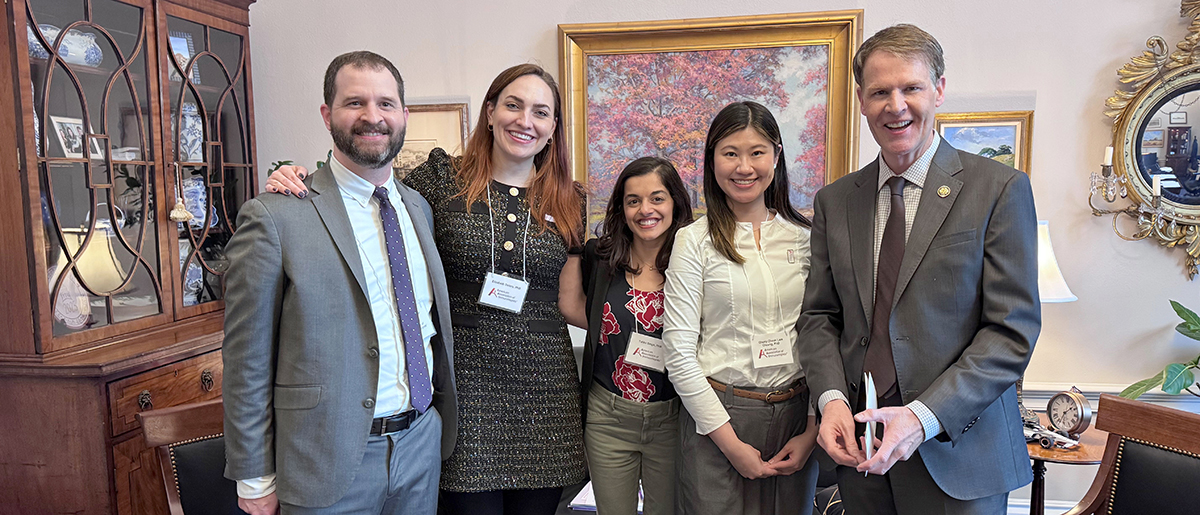
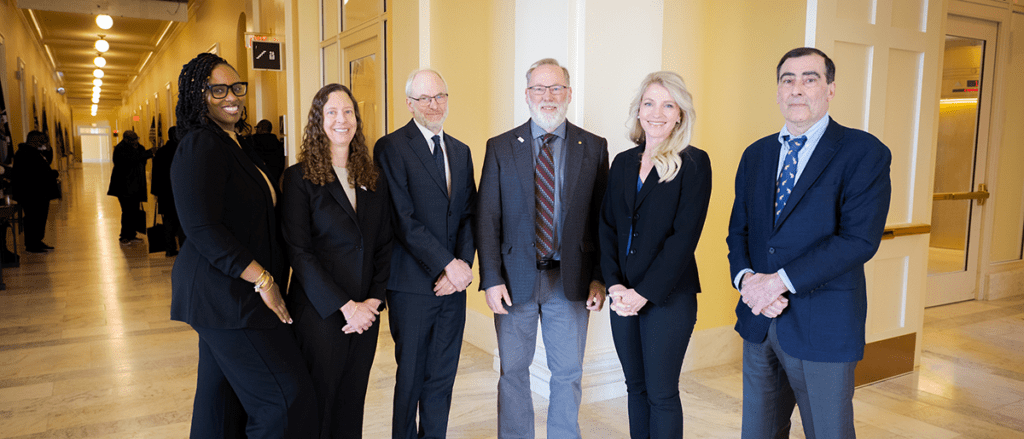
On March 18, AAI held a congressional briefing at the Cannon House Office Building in Washington, DC, to demonstrate how decades of basic immunological research has led to exciting new treatment options, and potential cures, for autoimmune diseases. The speakers included Nobel laureate Fred Ramsdell, PhD; immunologist Ignacio Sanz, MD; type 1 diabetes advocate Amanda Troutman; and lupus patient and advocate Shadé Mallory-Mason.
AAI Committee on Public Affairs Chair Lauren I.R. Ehrlich, PhD, and past AAI President Stephen Jameson, PhD, chaired the well-attended briefing. Staffers from congressional offices, officials from key federal agencies, and members of the public filled the briefing room.
Dr. Jameson opened the session with a focus on the importance of immunology to a wide range of health advances. He told the audience that “fundamental research on the immune system is leading to innovative and transformative therapies to treat—and potentially even cure—autoimmune diseases.”
In her introduction of the speakers, Dr. Ehrlich reminded the audience of the costs of autoimmune disease to the nation: at least 25 million Americans living with one (or more) of over 100 known diseases, and an annual economic burden of more than $168 billion for treatment. But decades of basic research discoveries and technological advancements have laid the foundation for new avenues of treatment that provide improved disease management and fewer side effects.
Recent Advances in Autoimmunity Research
The first speaker was Dr. Ignacio Sanz, who explained some immunology basics in understandable terms. He described how effective tolerance checkpoints work to prevent one’s immune system from attacking its own cells, tissues, or organs, and how various factors can break down that tolerance and lead to autoimmune disorders. Stressing the recent developments in CAR-T cell immunotherapy, used to treat cancer and now being tested in some autoimmune diseases, Dr. Sanz said that before 2023, the answer to “Can autoimmunity be cured?” was “If only…” but now, that answer was “It just might happen!”
To realize those cures, Dr. Sanz told the staffers that training and support for the next generation of young scientists is crucial. We are at a point in history when unprecedented advances are being made, but federal funding is necessary to support essential basic research.
A Treg Cell Primer
Dr. Fred Ramsdell outlined a brief history of treatments for autoimmunity, from broad spectrum chemicals, through highly targeted proteins to the cell-based therapies that can offer actual cures. Using the example of immunodysregulation polyendocrinopathy enteropathy X-linked syndrome (IPEX), a rare autoimmune disorder, he explained that functional regulatory T cells (Tregs) are necessary to maintain a normal immune system, and how those cells can be used as treatment.
There are more than two dozen ongoing clinical trials using Tregs in autoimmunity and transplantation. Dr. Ramsdell highlighted the widespread treatment possibilities of just this one avenue of immunotherapy, clarifying that it does not “go at the root cause of those diseases that are genetic and multifactorial, but can treat a lot of the pathology and damage caused by those diseases.”
New Hope for Type 1 Diabetes
Amanda Troutman related the story of her daughter’s type 1 diabetes (T1D) diagnosis in 2020 and the significant life disruption that management of the disease imposes. After her daughter’s diagnosis, her entire family took an at-home screening test and discovered that her son also had multiple T1D-related autoantibodies. A follow-up oral glucose tolerance test placed him in stage 2 of the disease. He had no symptoms at the time and luckily had not yet progressed to stage 3, or insulin-dependent, disease.
Two years later, a monoclonal antibody treatment for T1D, teplizumab-mzwv (Tzield), received FDA approval. Troutman’s son was still asymptomatic, and he immediately went on a two-week course of the new biological. That treatment has delayed the onset of stage 3 T1D for the last three years, allowing him to get through high school free of glucose and insulin management.
Troutman concluded her powerful story with the hope that now, the patient experience with T1D will look more like her son’s than her daughter’s, and that support for basic research will result in more therapies to delay—and eventually prevent altogether—onset of insulin dependency.
Immunotherapy for Lupus
The final speaker of the day was Shadé Mallory-Mason, who told the story of her diagnosis and struggles with lupus and the long road to find a successful treatment plan. Her experience began with a suite of unexplained symptoms that made a simple task like doing the dishes or washing her hair a painful, exhausting ordeal. After a misdiagnosis, she finally got confirmation that she had lupus and stage 5 kidney disease.
Mallory-Mason’s physician began “basically a trial and error” approach. At one point she was taking 17 different medications but couldn’t work because of the continuing pain and fatigue. Finally, a new rheumatologist suggested starting from scratch with just belimumab (Benlysta), a monoclonal antibody which restores the potential for autoantibody-producing B cells to undergo apoptosis. She entered remission.
In an especially emotional moment of the briefing, Mallory-Mason revealed that when she was first diagnosed, she did not know that lupus could interfere with her dream to become a mother. An active lupus flare, especially when it involves kidney disease, is dangerous for both mother and developing baby. “You’re already dealing with anxiety and this disease,” Mallory-Mason said, “and then you feel guilty for even wanting to become a mom.”
When she went into remission, however, she felt like that option had been given back to her by the immunotherapy. Just last autumn, she gave birth to a son after a healthy, normal pregnancy. Although her lupus has since flared up again, the successful treatment allowed that dream to come true.
Appeal for Sustained Investment
Dr. Jameson wrapped up the briefing with a final reminder that the stories of patients getting their lives back could not be told without sustained investment and well-supported basic science. Dr. Ramsdell reminded the audience that we are in a time of unprecedented advances: “If we had this conversation five years ago, the word ‘cure’ is probably not in the conversation. Are we there today? We’re not. Can I see that in my lifetime? Assuming I live long enough, I think we can.”