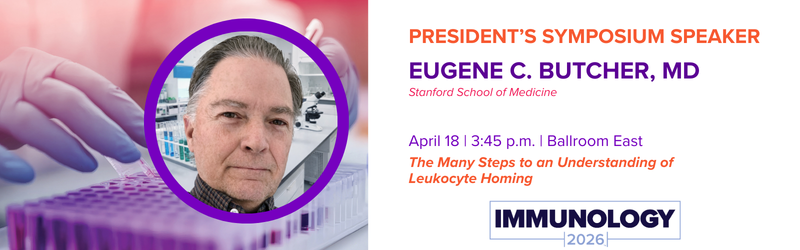
As part of the President’s Symposium on Saturday, April 18, at IMMUNOLOGY2026™, Eugene C. Butcher, MD, will speak on “The many steps to an understanding of leukocyte homing.” Dr. Butcher is Klaus Bensch Professor of Pathology at Stanford, and Director of the Laboratory of Immunology and Vascular Biology, Palo Alto VA Medical Center.
Dr. Butcher’s lab is interested in fundamental aspects of cell-cell recognition, migration and development with the mammalian immune system as a model. They use molecular and genetic approaches to study the development and trafficking of white blood cells, including their interactions with the endothelial lining of blood vessels at sites of leukocyte extravasation, their chemotactic responses in tissues, and their programming by environmental factors in lymphoid tissues and within mucosal surfaces.
We spoke with Dr. Butcher about his upcoming President’s Symposium lecture as part of a series of interviews with IMMUNOLOGY2026™ speakers.
How would you describe your lecture to a non-specialist in 30 seconds?
I’ll present the discovery of the multistep adhesion cascade through a personal and historical lens—how we learned that blood vessels display molecular address codes (“addressins”) that lymphocytes read step-by-step to identify organs and tissues for homing.
I’ll trace how the generalized multistep model—rolling, chemoattractant-mediated activation, and integrin-dependent arrest—emerged from early studies of lymphocyte recirculation and granulocyte recruitment in inflammation, revealing a sequential process that underlies the diversity, immunological significance, and therapeutic and diagnostic potential of immune cell trafficking
Why should immunologists know more about the adhesion cascade?
The multistep cascade is not simply a mechanism for getting leukocytes out of the bloodstream—it is a core organizing principle of the immune system. By controlling where and when immune cells develop, recirculate, and navigate within tissues, adhesion and chemoattractant cascades determine the location, timing, and character of immune and inflammatory responses. These mechanisms operate across the immune system.
The adhesion cascades offer largely unrealized opportunities for immune regulation and therapeutic targeting. Specialized trafficking programs that control homing present many additional opportunities to regulate the participation of NK cells, dendritic cells, and effector versus regulatory T cells in tissue-specific immunity, tolerance, and inflammation.
Finally, trafficking programs are not only therapeutic targets but also biomarkers of tissue-specific immunity. “ZIP codes” expressed on circulating T and B cells reflect organ-specific immune engagement, providing a largely untapped means of monitoring localized immune responses through the blood.
What was the path that led you to the research you are discussing in your talk?
I became interested early in how cells recognize each other and their environments to control their position and interactions in the body. As a pathology resident, I was fortunate to join Irv Weissman at Stanford at a time when physiologists had uncovered gut- versus skin-selective lymphocyte recirculation and homing, implying organ-specific recognition mechanisms by blood-borne lymphocytes that I found fascinating. Almost the day I started, Judy Woodruff published the Stamper–Woodruff assay of lymphocyte binding to high endothelial venules (HEV) in frozen sections. This remarkable model allowed us to discover that lymphocytes distinguish HEV from different tissues and to identify adhesion molecules involved.
These findings initially suggested a simple lock-and-key model of lymphocyte homing, but that model had to be jettisoned when we discovered that L-selectin also mediated neutrophil recruitment in inflammatory settings where lymphocytes are excluded. Since this same molecule mediated lymphocyte homing to lymph nodes where neutrophils were excluded, additional steps had to be involved.
Fortunately, Karl Arfors and others had already described discrete events in granulocyte–vascular interactions: rolling by unknown mechanisms, and integrin-mediated arrest and recruitment triggered by small peptide or lipid chemoattractant ligands. In seminal studies by AAI President Uli von Andrian and Karl, we showed in situ granulocyte rolling mediated by L-selectin. Mike Lawrence and Tim Springer reported neutrophil rolling on P-selectin at the same time.
This background led us to propose the generalized multistep model in which combinatorial mechanisms confer specificity and diversity in lymphocyte–endothelial recognition and, more broadly, in localized immune cell recruitment. Subsequent work confirmed GPCR signaling and chemoattractant cytokines in lymphocyte arrest; revealed many additional molecules involved in these cascades. It is now clear that specialized adhesion and chemoattractant cascades direct immune cell recruitment and navigation throughout the body.
What are you looking forward to at IMMUNOLOGY2026™?
Catching up with friends and colleagues, interacting with young scientists and students, and learning.