
This article is part of the AAI Teaching Tools series. More articles can be found in the Teaching Tools section. Archived articles can be found on the AAI website.
by John K. Cusick, PhD
Full Teaching Professor, Department of Medical Education, University of California, Merced
The purpose of this study was to use multiple forms of popular media to introduce immunology to medical students during the Foundations of Clinical Medicine (COM 501) course, the first required course in the curriculum at California Northstate University, College of Medicine. The Foundations course primarily takes place in the lecture hall. The main goal of the course is to introduce medical students to the various fields in the basic sciences; small group discussion sessions are also included on Fridays to teach students how to read and interpret clinical cases. We utilized the television series Cells at Work! (CAW) and the 1978 movie, Invasion of the Body Snatchers (IBS), to supplement the introduction of immunology to students.
Cells at Work!
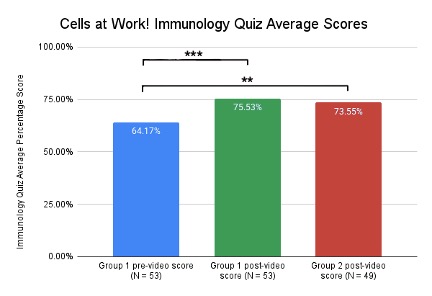
CAW explains multiple aspects of immunology and hematology through Japanese anime. Students participating in the study were divided into two groups and asked to watch CAW episodes (Influenza and Acquired Immunity) prior to the first scheduled immunology session. Group 1 completed a formative quiz both before and after watching two CAW episodes that introduced immunological concepts. Group 1’s performance on the formative quiz improved from 64.2% to 75.6%, a significant improvement (p value = 0.00024) as determined by a Wilcoxon signed-rank test (Figure 1). Group 2 completed the same quiz only after watching the two episodes, and a Mann-Whitney U test was used to compare Group 2’s post-viewing quiz performance with Group 1’s pre-viewing quiz performance.
Group 2 (n=49) had a significantly higher post-video quiz average of 73.6% in comparison to Group 1’s (n=53) pre-video average of 64.2% (p value =0.0024). Assessment of students after their first summative exam (n=79), which was administered two weeks after viewing the CAW videos, revealed that 97.5% of students felt that CAW would help introduce immunology to first-time learners. The strong response received by students after they had time to reflect may be due to how well videos such as CAW are at using entertaining stories to introduce scientific content in a manner that is not intimidating.
Invasion of the Body Snatchers
The IBS movie analogy was inspired and adapted from the previously reported “Zombie Pirate Invasion” analogy for immunology presented at IMMUNOLOGY2022™. Analogies are very useful teaching tools that connect new complex ideas to concepts that students are already familiar with, greatly assisting both the comprehension and future recall of new abstract ideas. In the IBS movie, invaders from outer space create human replicas, and the uninfected humans must decide how to fight the invasion while also discerning which people they encounter are uninfected humans versus invaders. This analogy highlights the challenges the immune system faces in eliminating transformed or virally infected cells.
Students were asked 1) how they would defend the campus from the invaders (i.e., innate immunity), 2) how they could distinguish an uninfected human from an invader (i.e., tolerance to self), 3) how the students could train to fight the invaders (i.e., generative lymphoid organs), 4) how they would communicate with each other while fighting the invasion (i.e., cytokines), 5) how they would kill invaders without killing uninfected humans (i.e., preventing autoimmunity), and 6) how they would ensure future generations remember how to kill invaders (i.e., immunological memory). For example, human bodies overtaken by the invaders in the movie never showed emotion and therefore could be detected by altered behavior. Similarly, lymphocytes scan cells for altered behavior, as CD8+ T cells kill cells when detecting abnormal expression of peptides presented by MHC Class I, and Natural Killer lymphocytes kill cells that either express excessive stress ligands or lack expression of MHC Class I.
84.2% of students (n=76) immediately assessed afterwards enjoyed and were engaged by the analogy and 82.0% of students assessed after their first summative exam (n=61) felt exposure to the analogy increased their confidence in learning immunology. As faculty members, we can often sense the apprehension and stress that students may experience when introduced to conceptually challenging subjects. The use of entertaining analogies can help students learn important foundational concepts in a manner that is engaging and fun.
In summary, both exercises were deemed effective by medical students for introducing immunology, and these activities are suitable for introducing immunology to students in other professional schools, undergraduate universities, or high schools. Current students are more attuned to popular media than previous generations, and the use of multimedia combined with analogies can help make immunology less intimidating to the novice learner.
Acknowledgements: The author would like to thank the following from California Northstate University, College of Medicine, who participated in conducting this research study: Richard Ma, Tianyu Luo, Dylan Cooper, Samantha Wong, Ashley Ko, Evan Cho, Nathaniel Tsai, Justin Ji, and Dr. Valerie Gerriets, Ph.D.
This study was supported by seed grants from California Northsate University, College of Medicine, and from California Northstate University, Institute for Teaching and Learning Excellence (ITLE).