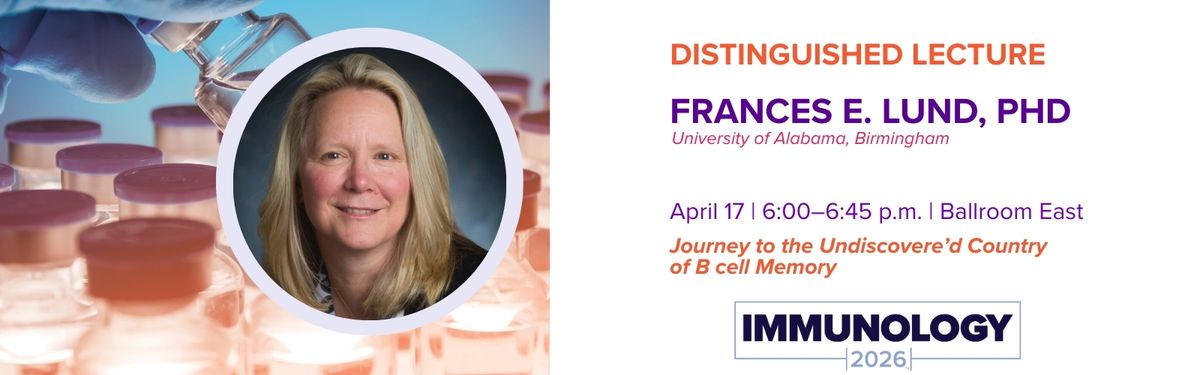
Frances E Lund, PhD, will give a Distinguished Lecture, “Journey to the undiscovere’d country of B cell memory,” on Friday, April 17, at IMMUNOLOGY2026™. Dr Lund is Professor of Microbiology, Endowed Chair in Immunology, and Director of the Heersink School of Medicine Immunology Institute at the University of Alabama, Birmingham.
While scientists have long recognized that B cells make antibodies that label bacteria and viruses for destruction by the immune system, Dr. Lund’s group showed that B cells also produce chemical signaling molecules called cytokines and demonstrated that the cytokines made specifically by B cells can alter the magnitude, duration and quality of the immune response that is generated in response to pathogens, allergens and autoantigens.
We spoke with Dr. Lund about her upcoming Distinguished Lecture as part of a series of interviews with IMMUNOLOGY2026™ speakers.
AAI: How would you describe your lecture to a non-specialist in 30 seconds?
Lund: In my lab we study the immune system, which represents the collection of cells and organs that are designed to help our body repel pathogens and keep us safe. My group focuses on a white blood cell population found in your blood and in tissues, called B lymphocytes or B cells. B cells, when activated by pathogens and other cells of the immune system, can start producing and secreting proteins called antibodies.
The antibodies made by antibody-producing B cells are important as the antibodies can bind to the pathogen and either kill it or help the body kick the pathogen out. When we are exposed to pathogens, like viruses or bacteria, the antibody producing B cells can either do their job in a quick burst and then die or some of them can remain in the body for many years and continue to produce the protective antibodies.
We want to understand why some B cells are durable and live for many years while others do not. We think that this is an important question because it might in the future allow us to design therapies or vaccines that would elicit the B cells and antibody producing cells that can live and protect us for a lifetime.
AAI: What was the path that led you to the research you are discussing in your lecture? What development in this field are you most hopeful for in the near future?
When I was a graduate student 35 years ago, my thesis project was focused on how cytokines contributed to the formation of antibody secreting cells (ASC). At that point, there was only 10 interleukins to study and an ELISPOT or a plaque assay with sheep red blood cells was the only method that could be used to reproducibly identify an ASC. 35 years later, I’m still studying the same broad question – how do cytokines and other soluble mediators control B cell fate decisions and what signals control durable B cell memory in the form of long-lived ASC and memory B cells. Thankfully, we have better research tools now and can ask the same question in a more sophisticated manner.
However, despite the advances we have made to answer fundamental questions about the immune system, our understanding of how lymphocyte fate decisions are programmed, particularly in non-lymphoid tissues, is still incomplete. This lack of knowledge continues to limit our ability to modulate immune responses using vaccines and immunotherapies. That being said, emerging data showing efficacy of CAR-T therapy in treating SLE is very exciting and suggests that we may be able to influence the size and functionality of pathogenic autoreactive B cells in tissues.
AAI: The title of your lecture makes reference to Hamlet; is there a connection to the questions raised in that soliloquy?
Lund: The title of my talk includes the phrase “undiscovere’d country”, which is plucked from Shakespeare and is a line in Hamlet’s 4th soliloquy. That soliloquy starts with the very famous “to be or not to be: that is the question”. Hamlet was musing in his soliloquy about what happens after we shuffle off this mortal coil to the great unknown (death). While I’m getting older now, I’m not currently musing about death, but I’ve been around long enough now to appreciate how a career in science has given me a lifetime to explore the undiscovere’d country that is the immune system and to ask the fundamental question of how cells in the immune system choose their fate and decide to “be or not to be” a long-lived cell or to “die: to sleep; no more”.
AAI: What can we look forward to at your “Deep Dive”?
Lund: This is the first “Deep Dive” that I have participated in, so I’m not sure exactly what to expect. I am looking forward to meeting with trainees and early career investigators and getting an opportunity to dig deeper into the topic how type I inflammatory responses due to infection, autoimmunity or transplant rejection might shape the lifespan and function of B cells.
AAI: What is your favorite part of the AAI annual meeting?
Lund: I have two interrelated favorite aspects of the AAI meeting. First, I love the opportunity to catch up with old friends, particularly those from my graduate and post-doctoral training days. Many of us specialized in different areas of immunology and we don’t run into each other at the more specialized immunology meetings. The annual AAI meeting is great because it brings together all the immunologists across the many subdisciplines.
This brings me to my second favorite part of AAI meetings. I use the meeting as an opportunity to attend the symposia that are focused on areas of immunology that I don’t think about every day. The annual AAI meeting is the venue that provides me with my continuing immunology education. So, in a nutshell, I love AAI because it’s the place where I see my compatriot trainees and the place where I continue my lifetime training in the field that I love—immunology!
Don’t miss Dr. Lund’s Distinguished Lecture! Register for IMMUNOLOGY2026™ today.